The 12 Best Beaches in Mauritius
Last updated: June 2026 · By Bilaal Sadeer
I have been photographing Mauritius's beaches for 15 years. I have stood on all of them at sunrise and at golden hour, in the dry season and the wet, with calm lagoons and choppy swells. This ranking is not compiled from a tourism board checklist — it is built from personal experience: the quality of the light, the texture of the sand, the colour of the water, how crowded a beach gets in July, and what it looks like through a camera lens at 6am. If you are planning a trip to Mauritius, or a beach shoot, this is the guide I give every couple who asks me where to go.
Mauritius Beaches — Key Facts
- Mauritius has 160+ km of coastline across four distinct coasts — North, East, South and West.
- The East coast (Belle Mare) has the calmest, most turquoise water — protected by a wide, deep offshore reef.
- The West coast (Flic en Flac) faces the setting sun and delivers the island's best golden-hour light for photography.
- The South-west (Le Morne) combines a UNESCO-listed cliff with a mirror-calm lagoon — the most dramatic beach on the island.
- Peak season May–November — cooler, drier, calmer seas, and the best natural light for outdoor photography.
- Best beaches for photography: Le Morne at sunset, Belle Mare at sunrise, Cap Malheureux with its iconic red church.
How I Ranked These Beaches
A beach ranking from a travel blogger who visited for a week and a ranking from a photographer who has worked every beach on the island for 15 years are different things. My criteria reflect both the visual qualities that matter to a photographer and the practical qualities that matter to anyone visiting Mauritius — couples, families, honeymooners and solo travellers alike.
Photography light is my primary criterion. This means the direction the beach faces, the quality of light at golden hour (sunrise or sunset), whether the water surface creates reflections, and how the natural scenery frames a subject. A beach that faces west gets direct sunset light; a beach that faces east gets the best sunrise. Le Morne faces south-west and catches the most dramatic golden hour on the island because the light hits the cliff face from the side and paints everything amber.
Water colour is the second criterion. Mauritius's lagoon water ranges from pale mint in shallow, sandy areas to deep electric turquoise over coral and patches of deeper sand. The best water colours are found on the east coast — Belle Mare, Trou d'Eau Douce — where the reef creates a consistently vivid aquamarine. Blue Bay in the south-east is the exception: its marine park waters have a depth and clarity that produces extraordinary colour even in the middle of the day.
Sand quality matters both visually and practically. The finest, whitest sand is found on the east coast and the south-west. The west coast (Flic en Flac, Tamarin) tends towards slightly coarser, off-white sand, though this is offset by the extraordinary sunset light. Crowds and accessibility complete the picture — a beautiful beach that is impossible to photograph cleanly because of sunloungers and boat traffic is a lesser proposition than a quieter beach with equivalent scenery.
Le Morne Beach
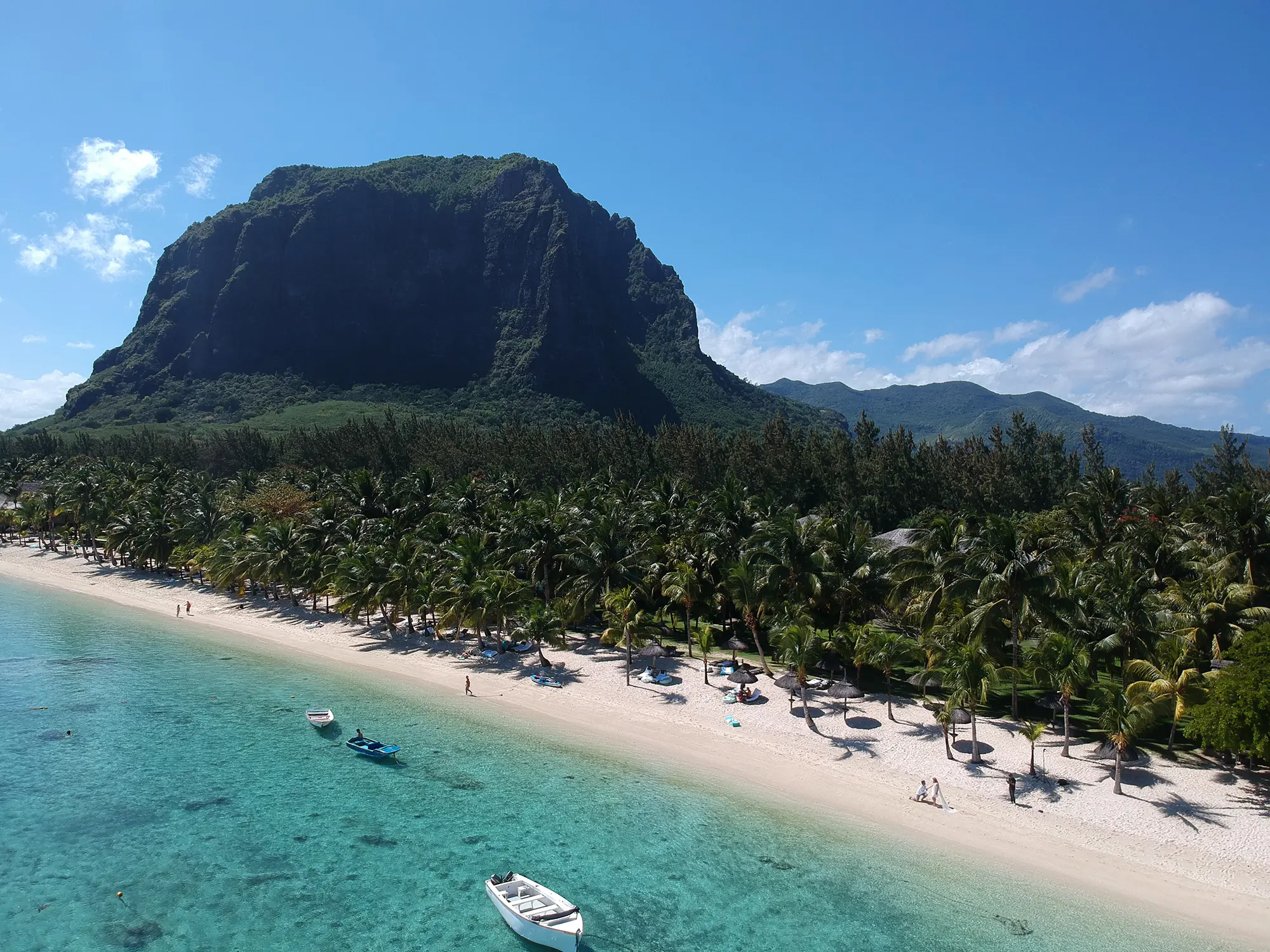
Le Morne is the defining beach of Mauritius. The UNESCO-listed Le Morne Brabant mountain rises 556 metres behind a lagoon of extraordinary colour — aquamarine near the shore, deepening to cobalt at the reef — with powdery white sand that stretches for kilometres in both directions. There is nothing else like it in the Indian Ocean. The mountain provides a vertical backdrop that ground-level photography simply cannot replicate; from a drone at 40 metres, the silhouette of the cliff against the turquoise lagoon is the single most striking aerial image in Mauritius.
The water conditions at Le Morne are exceptional for most of the year. The lagoon is large and well-protected, with consistent depths of 1–2 metres over the inner sand. The famous underwater waterfall optical illusion — visible from the air, where sand cascades off the reef shelf and creates the appearance of a submerged cataract — is one of the most photographed natural phenomena in the Indian Ocean. It is best captured by drone from above the outer reef.
The best photography time is from approximately 90 minutes before sunset until 15 minutes after. The light hits the mountain from the south-west, casting a golden side-light across the cliff face while the lagoon catches the last warm reflections from the sky. As a couple portrait location, it is unmatched. Nearby, Paradis Beachcomber and Lux Le Morne both have direct beach access and are among my most-worked locations on the island. See my Le Morne photography guide.
Belle Mare Beach
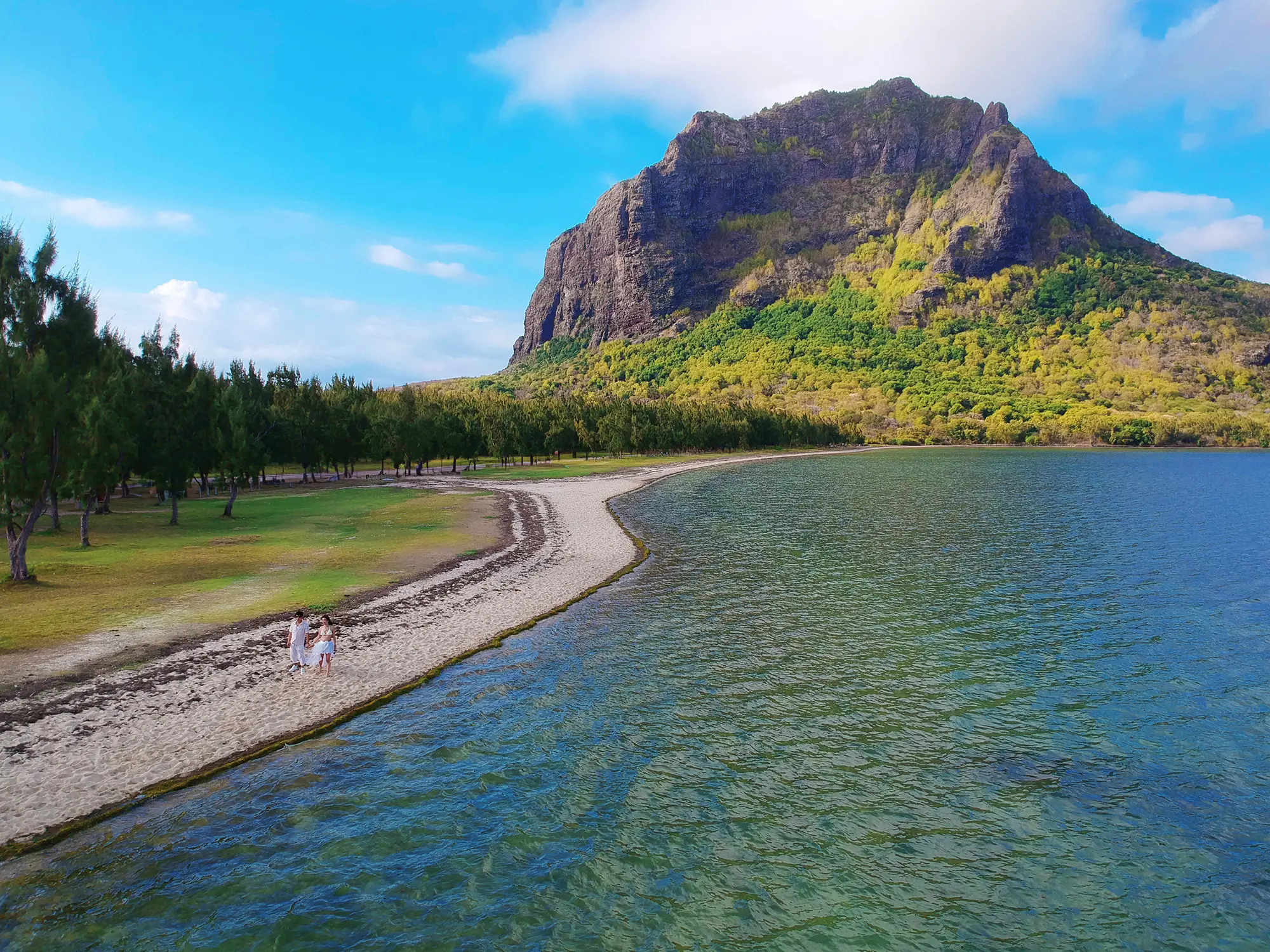
Belle Mare is the east coast's crown jewel — a 9-kilometre stretch of white sand backed by casuarina trees, facing a lagoon that changes colour through the day in ways that make it impossible to photograph badly. At sunrise, when the low sun catches the mirror-calm water from the north-east, the lagoon turns a shade of turquoise that is genuinely unlike anything you will see on a screen — it has to be experienced in person to be believed. This is why I recommend Belle Mare specifically to couples shooting at sunrise: the light and the water work together in a way that the west coast at sunset, for all its drama, cannot quite match.
The water at Belle Mare is the calmest on the island. A wide, deep reef sits well offshore, absorbing swell before it reaches the lagoon. Swimming is safe, the sand underfoot is clean and white, and the shallow water extends far enough from shore to walk in knee-deep water for hundreds of metres. For families, this makes it the most accessible luxury beach on the island. For photographers, the clean water and open horizon mean long exposure shots at sunrise — with the casuarina trees reflected in the still lagoon — produce genuinely gallery-worthy results.
Nearby hotels include Constance Belle Mare Plage and Shangri-La Le Touessrok — both of which I work with regularly for honeymoon and couple photography. The beach is also public for much of its length, accessible from the coastal road. See my Belle Mare photography guide.
Blue Bay Beach
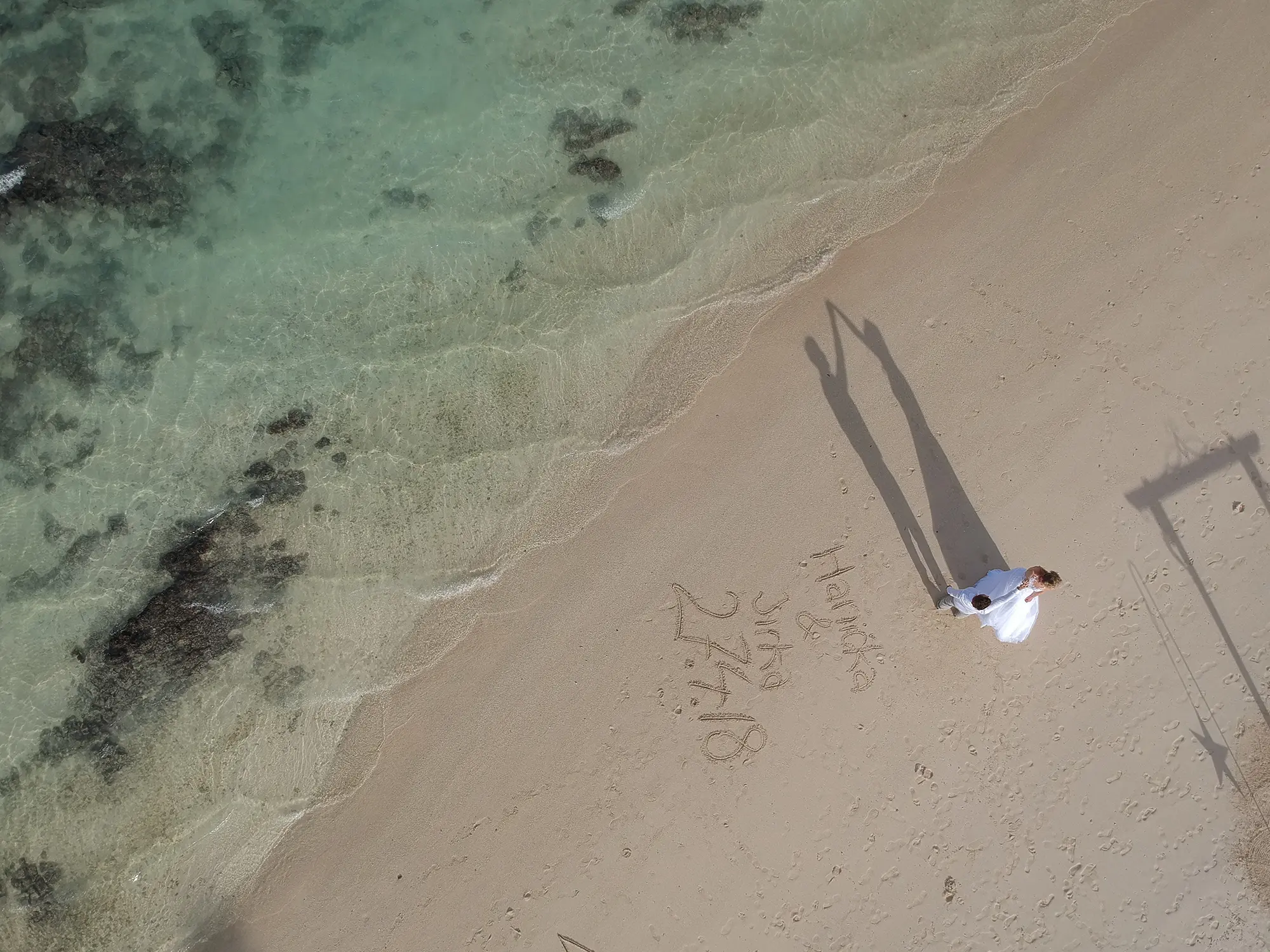
Blue Bay occupies a unique position in this ranking because it wins on a criterion none of the other beaches can match: the quality of its underwater world. The Blue Bay Marine Park protects one of the finest coral gardens in the Indian Ocean — staghorn corals, brain corals, table corals and vast coral heads in water so clear that visibility regularly exceeds 20 metres. Parrotfish, pufferfish, sergeant fish and green sea turtles are routine sightings. You can snorkel directly off the beach without a boat.
Above the waterline, Blue Bay is a genuinely beautiful beach in its own right. The bay is enclosed, which means the water is always calm — even on days when the trade winds pick up elsewhere on the island. The sand is white, the palm trees lean over the water in the photogenic way that calendar photographers dream about, and the bay's south-east orientation means it catches the light well in both morning and late afternoon. The surrounding area of Mahebourg, close by to the north, adds historical interest — the Mahebourg Waterfront Museum tells the story of the 1810 Battle of Grand Port, the only French naval victory over the British in the Napoleonic Wars.
Blue Bay is best reached from the south of the island and is approximately 45 minutes from Port Louis. Nearby accommodation options include Shandrani Beachcomber. For photography, mid-morning light on the water surface produces exceptional underwater colour when shooting from the beach looking seaward. See my Blue Bay photography guide.
Trou aux Biches
Trou aux Biches — literally "the hole of the does" — is the north coast's most consistently beautiful beach, and one of the best-known on the island. The bay shape creates naturally sheltered water, and the offshore reef keeps the lagoon glassy calm for most of the year. The sand here is among the finest on the island: powdery white, with a gentle slope into the water that makes wading in a pleasure rather than a scramble over rocks.
Photographically, Trou aux Biches works best in the mid-morning and late afternoon. The beach faces roughly north, which means it does not get dramatic side-light at golden hour in the way that west-facing or east-facing beaches do — but the quality of the diffused tropical light throughout the day is consistently good, and the clean water and pale sand mean that any time from 8am to 4pm produces usable results. The bay is long enough that finding a quiet stretch away from the hotel sunlounger rows is straightforward, particularly at either end.
The nearby Trou aux Biches Beachcomber Resort is one of the island's finest five-star properties and a regular venue for weddings and honeymoon shoots. The hotel's beach stretches directly onto the public beach, and the transition from resort to public sand is seamless. I photograph couples here regularly — the combination of clear water, manageable crowds and consistent light makes it a reliable choice for morning beach portrait sessions. See my Trou aux Biches photography guide.
Flic en Flac
Flic en Flac is the west coast's beating heart — a 5-kilometre beach backed by a lively village that has grown over the decades into Mauritius's most popular local beach destination. Unlike the quiet resort beaches of the east and south-west, Flic en Flac has energy: locals swim here in the evenings, food stalls line the coastal road, and the beach is genuinely alive in a way that the manicured resort beaches are not. For travellers who want to experience beach life as Mauritians actually live it, Flic en Flac is essential.
The photography case for Flic en Flac is built entirely on its sunsets. The beach faces almost due west, with a clean horizon and no obstructions — the sun drops straight into the sea, and in the 30 minutes before it does, the sky turns through amber, orange and deep gold in a display that I never tire of photographing. The west coast's trade wind swells also create more texture on the water surface than the sheltered east coast lagoons, which adds visual interest to seascape shots. The sand is slightly coarser and more off-white than the east coast's, but the light makes up for it completely.
Nearby hotels include Sugar Beach Resort and La Pirogue Resort, both of which sit directly on the beach. For couples, I recommend a late-afternoon arrival in Flic en Flac — start with a walk along the public beach to find the right backdrop, then shoot the last 45 minutes of light as the sun descends. Results are consistently outstanding. See my Flic en Flac photography guide.
Cap Malheureux
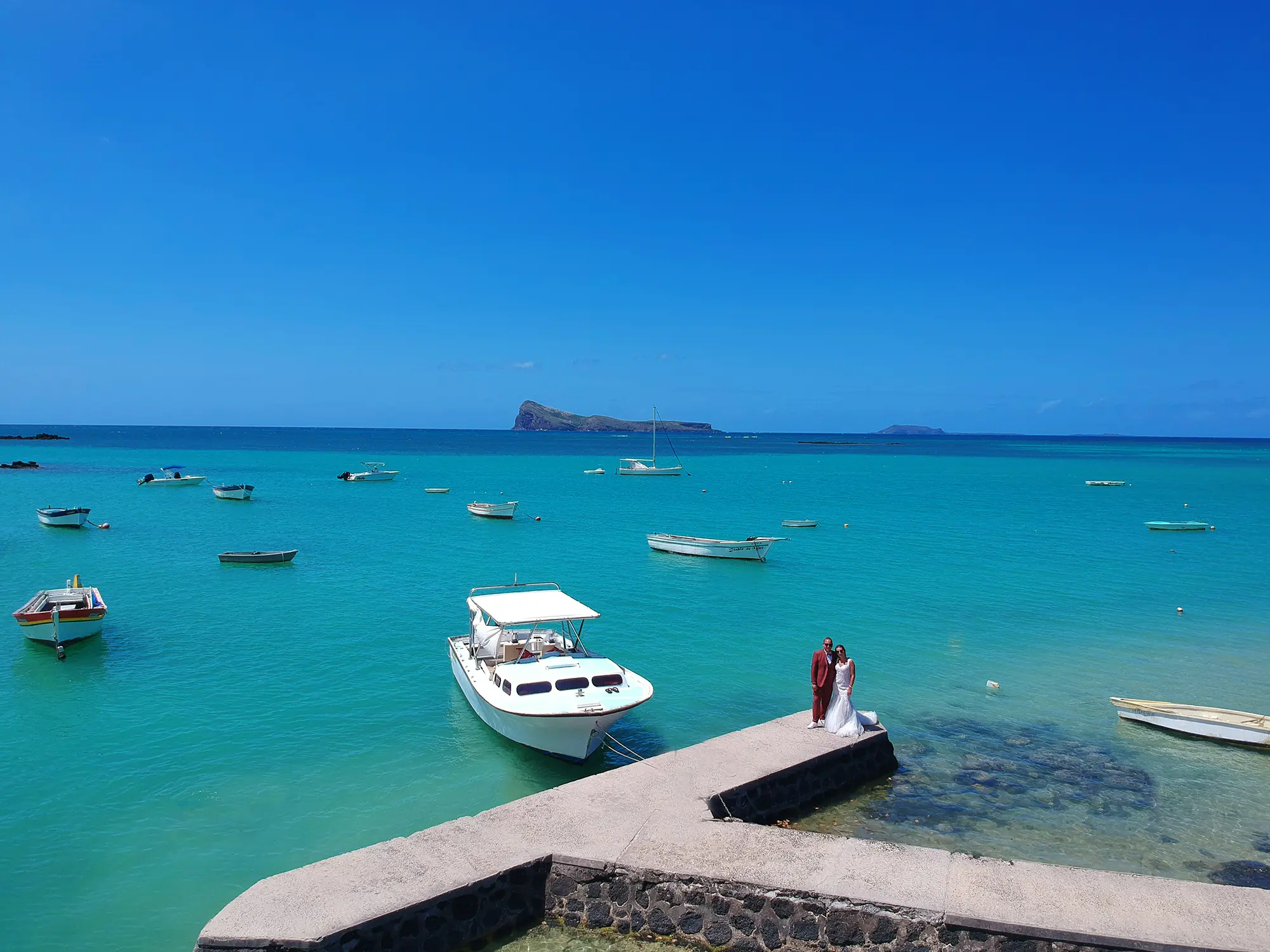
Cap Malheureux — "Cape of Misfortune," named for the 1810 British landing during the Napoleonic Wars — is home to the most photographed building in Mauritius: the red-roofed Notre-Dame Auxiliatrice church, which sits at the water's edge with the small island of Coin de Mire visible in the background across a vivid blue-green sea. This image is on more Mauritius postcards, travel magazines and photography portfolios than any other single scene on the island. The combination of the colonial church's red roof, the white-washed walls, the palm trees and the turquoise sea is so compositionally perfect that it requires almost no photographic skill to produce a strong image.
The beach at Cap Malheureux itself is small and not particularly suited for swimming — rocky in places, with a shelf that drops quickly. But the northern tip of the island is consistently beautiful as a landscape: the view north towards Coin de Mire and Flat Island on a clear May morning, with the trade wind clouds building above the horizon, is one of the finest views in Mauritius. For photography, early morning light before 9am produces the best results — the church faces roughly east, and morning light catches its front facade directly.
For couples wanting the iconic church backdrop for portraits, I recommend arriving at sunrise or in the golden hour before sunset — the crowds that gather during the day largely disappear at both ends of the day. The nearby Cap Malheureux region guide covers the full northern tip of the island, including Anse la Raie and the less-visited beaches to the east of the cape.
Pereybere
Pereybere is the north coast's best-kept open secret — a small, curved public beach tucked between Grand Baie and Cap Malheureux that offers consistently excellent swimming in a naturally sheltered bay. The water here is the clearest on the north coast: a pale aquamarine over white sand, with snorkelling possible directly off the beach. Unlike the more developed Grand Baie to the south, Pereybere retains a relaxed, local atmosphere — families and young Mauritians dominate on weekends, and the beach never reaches the crowded critical mass of the island's busiest spots.
Photographically, Pereybere works well in the early morning when the light comes from the east and the water surface is at its most glassy. The compact bay shape means that a wide-angle lens from either headland captures the full sweep of sand and water in a single frame. The beach's natural enclosure by the headlands also means that wind rarely disturbs the water surface here, even when the trade winds are strong elsewhere. For aerial photography, Pereybere's bay shape and clear water make for a striking composition when viewed from above.
There are no five-star hotels directly on Pereybere beach — accommodation is mostly villas, guesthouses and smaller boutique properties in the village. This is precisely what gives the beach its character. For couples staying in Grand Baie or Cap Malheureux, Pereybere is a 10-minute drive and consistently delivers better swimming and cleaner photography conditions than Grand Baie itself. See my Pereybere photography guide.
Mon Choisy
Mon Choisy is one of the longest public beaches on the island — a sweeping 2-kilometre arc of pale sand backed by a shaded grove of casuarina and filao trees that provides natural relief from the midday heat. The beach faces north-west, which gives it a pleasant light in the late afternoon that is warmer than the mid-morning east-coast light but less dramatic than Flic en Flac's direct-west sunsets. It is a beach that photographs best in the 2 hours before sunset, when the low angle light rakes across the sand and the trees cast long shadows.
The casuarina grove at Mon Choisy is one of the most underrated photography backdrops on the island. The dappled light filtering through the needles creates a soft, natural fill light that flatters skin tones in portrait photography — particularly in the 90 minutes before sunset when the direct light is warm. Couples who want something different from the standard beach portrait often appreciate the visual variety of the grove combined with the open sand and water immediately adjacent.
Mon Choisy is a popular family beach and can be busy on weekends, particularly near the car park. The eastern end of the beach, a 10-minute walk from the main public access, is considerably quieter and often completely empty on weekdays. See my Mon Choisy photography guide.
Tamarin
Tamarin Bay on the west coast is where Mauritius's surf culture lives. A consistent wave break — produced by a gap in the reef that allows south-westerly swells to enter the bay — has made Tamarin a destination for surfers since the 1970s, and the village that has grown up around the bay retains a relaxed, independent spirit that is very different from the five-star resort world of Belle Mare or Le Morne. For travellers looking for character over perfection, Tamarin delivers.
Photographically, Tamarin is most compelling at sunset — the west-facing beach catches the same golden-hour light as Flic en Flac, but with the added visual interest of the surf break and, if the conditions are right, dolphins that frequently enter the bay in the early morning hours. Tamarin Bay is one of the few places in Mauritius where you can reliably see dolphins close to shore, particularly between 6am and 9am during the months of June to October. Dawn dolphin photography from the beach, with the Tamarin mountains behind and the first light breaking over the eastern ridge, is one of the more extraordinary photographic experiences the island offers.
Note that Tamarin is not a calm-water swimming beach — the surf break means conditions can be rough, and the bay is not suitable for young children when swells are running. For photography purposes this is an advantage: the texture and movement of the water adds energy to seascape shots that the glassy east coast lagoons cannot provide. See my Tamarin photography guide.
Bain Boeuf
Bain Boeuf is the north coast's most secluded beach — a small cove at the island's northern tip, just east of Cap Malheureux, that sees a fraction of the visitors who crowd into Grand Baie or Pereybere. The name translates roughly as "ox bath," a reference to the centuries-old agricultural use of the foreshore. Today the beach is a quiet, locals-favoured spot with a shallow, sheltered lagoon, clear water over white sand, and the kind of untouched natural character that becomes increasingly rare as Mauritius's coastline develops.
For photography, Bain Boeuf offers something genuinely rare on this island: a north-coast beach where it is realistic to be alone at sunrise. The small parking area, the lack of hotel development directly on the beach, and the limited tourist awareness of the location mean that early morning visits are almost always crowd-free. The view north across the channel towards Coin de Mire — with the first light catching the island's volcanic silhouette — is one of my favourite compositions on the island.
The beach is best visited on weekdays, when even the local crowd is minimal. On weekend afternoons, Mauritians arrive in family groups with picnics and music, which gives the beach an entirely different but equally authentic atmosphere. There is no major hotel directly on Bain Boeuf — nearby accommodation is found in Cap Malheureux village and the surrounding area. See my Bain Boeuf photography guide.
Grand Baie
Grand Baie is Mauritius's tourism capital — the island's most developed resort town, with a marina, shopping centres, restaurants, water sports operators, and a beach that is simultaneously the most visited and the most commercialised on the island. In terms of raw beauty it ranks lower than almost every other beach on this list, but its position here reflects its practical significance: Grand Baie is where most tourists are based, and understanding what it offers — and what it does not — is essential for anyone planning a Mauritius beach visit.
The public beach at Grand Baie is genuinely pleasant in the early morning, before the water sports operations start up and the sunlounger rows are fully occupied. The bay is large and well-sheltered, the water is clear, and the view across to the northern islands on a clear morning is attractive. For swimming, it is perfectly adequate. For photography, it requires careful framing to exclude the infrastructure, and is best approached as a morning exercise before 8am.
Grand Baie's real value for visitors is logistical: it is the departure point for glass-bottom boat trips to the northern islands (Île Plate, Coin de Mire, Île aux Cerfs by speedboat), for catamaran day trips around the island, and for the boat excursions to the underwater waterfall area near Le Morne. If you are staying in Grand Baie, the best beaches — Pereybere, Cap Malheureux, Mon Choisy — are all within a 15-minute drive. See my Grand Baie photography guide.
La Prairie
La Prairie, on the south-east coast near Mahebourg, closes this list as an intentionally off-the-beaten-track choice — a beach that rewards those who seek it out with a raw, undeveloped coastal landscape that is increasingly rare in Mauritius. The south-east coast receives less tourist infrastructure than the island's other coasts, which means beaches like La Prairie have retained a natural character that more developed areas have lost. The horizon here faces south-east towards the open Indian Ocean — on windy days, the sea has genuine swell and energy; on calm days, the lagoon clears to a pale jade.
The photography case for La Prairie is built on its emptiness and its light. Early morning on the south-east coast in June or July produces a cool, clear, directional light that is qualitatively different from the warmer, hazier east coast sunrise. The combination of the open horizon, the wide lagoon and the absence of other people creates a meditation-like quality in photographs taken here — space, stillness, and a sense that the Indian Ocean begins at the edge of the sand and extends, uninterrupted, for thousands of kilometres.
La Prairie is best reached by car from Mahebourg (approximately 10 minutes south). There are no major hotels directly on the beach, though the nearby La Prairie region has several smaller guesthouses and self-catering villas. For travellers who have already visited the island's headline beaches, La Prairie offers something genuinely different: a reminder of what Mauritius's coastline looked like before the resorts arrived.
The Photographer's Coast Guide
Mauritius is a small island — roughly 60km north to south and 40km east to west — but its four coasts have markedly different characters, light qualities and sea conditions. Understanding these differences is the foundation of planning any Mauritius beach photography session.
North Coast — Colour and History
The north coast runs from Grand Baie to Cap Malheureux and is the most developed and most visited part of Mauritius's coastline. It faces north and north-west, which means it catches warm afternoon light and — at the very tip of the island — the extraordinary view north towards the outer islands. Trou aux Biches has the finest sand and most consistent calm water on this coast; Pereybere has the best swimming clarity; Cap Malheureux has the iconic red church. Best golden-hour direction: north-west in the late afternoon, where the sun angles across the headlands and catches the water surface from the side. Best photography window: 4:30pm to 6pm.
East Coast — Sunrise and Serenity
The east coast is where the island's finest resort beaches are concentrated: Belle Mare, Palmar, Trou d'Eau Douce. The coast faces east, which means it catches the first light of the day — and in the hour after sunrise, when the sun is still low and the trade winds have not yet picked up, the east coast lagoon in June produces some of the most extraordinary natural light I have seen anywhere in the world. The water is the calmest and most turquoise on the island year-round. Best photography window: 6am to 8am for sunrise portraits. Completely different mood from the west coast at sunset — softer, cooler, more ethereal.
South and South-West — Drama and UNESCO Heritage
The south-west is dominated by Le Morne and its UNESCO cliff — the most dramatically photogenic beach in the Indian Ocean. The southern coast from Bel Ombre to Mahebourg is less developed and more rugged, with a wilder sea character that suits landscape photography. Blue Bay, in the south-east, is the finest snorkelling destination on the island. The south coast faces into the prevailing trade wind swells, which means conditions can be rougher than the north or east — but for seascape photography, the texture and energy of the water add visual interest that the calm lagoons cannot match. Best golden-hour direction: south-west facing beaches (Le Morne, Bel Ombre) at sunset.
West Coast — Sunset and Energy
The west coast is the sunset coast. Flic en Flac and Tamarin face due west into the Indian Ocean, and on a clear evening in May or October the sun drops below the horizon in a display of amber and orange that is genuinely spectacular. The west coast also has a different energy from the east — more local, more alive, less resort-formal. The surf culture at Tamarin, the food stalls at Flic en Flac, the dolphin boat trips from Black River all contribute to a coastline that feels lived-in. For photography, the west coast is the best side of the island for golden-hour couple portraits: the direct sunset light requires no reflector or fill flash, and the warm colour temperature flatters every skin tone. Best photography window: 5pm to 6:30pm (sunset time varies by season — approximately 5:45pm in June, 7pm in December).
Best Beaches in Mauritius — FAQ
Capture Your Mauritius Memories
Drone aerials. Golden-hour portraits. The turquoise lagoon as your backdrop. 15 years shooting Mauritius's most beautiful beaches.