Chamarel — Seven Coloured Earth, Waterfall, Rum and Photography
Last updated: June 2026 · By Bilaal Sadeer
Chamarel is unlike anywhere else on the island — and I would argue unlike anywhere else on earth. A plateau village in the hills of south-west Mauritius, it sits between the ocean and the national park, and within five minutes of each other you have two of the most visually extraordinary natural phenomena in the Indian Ocean: volcanic dunes in seven distinct colours and a waterfall that drops 100 metres into a forested gorge. Add the island's only single-estate rum distillery and the trailhead of Black River Gorges National Park, and Chamarel is a full day's itinerary by itself. I have photographed couples here hundreds of times. This guide covers everything you need to know — the geology, the logistics, the photography positions, and exactly how to structure your day.
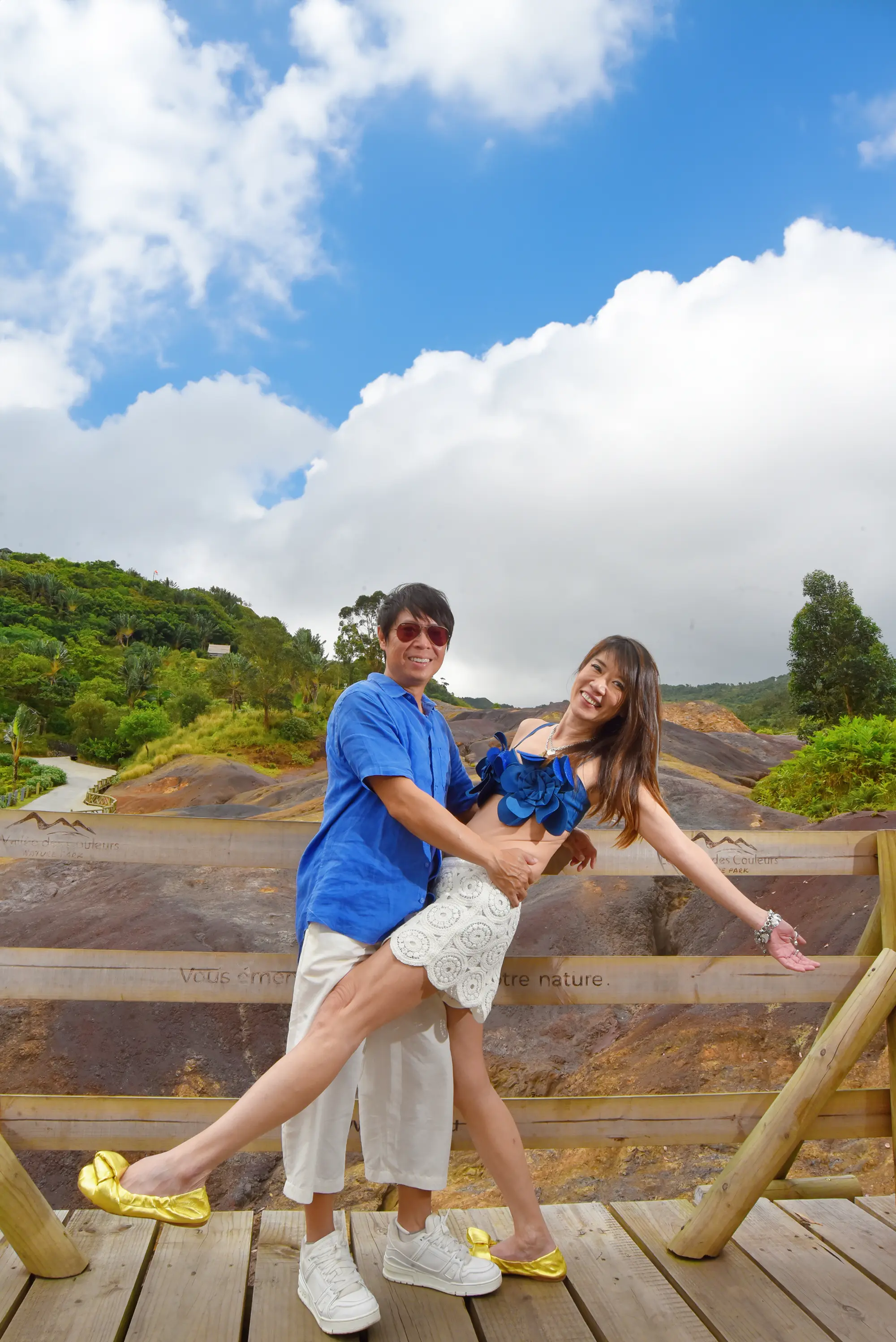
Chamarel, Mauritius — Key Facts
- Seven Coloured Earth: volcanic dunes in 7 distinct colours — best seen from the viewpoint 5 minutes from the car park. Entry €8.
- Chamarel Waterfall: 100m drop into a ravine, viewable from above via a 15-minute walk. No swimming.
- Chamarel Rum Distillery: artisan single-estate rum, tours + tasting approximately €20 per person.
- Black River Gorges National Park: trailhead starts 10 minutes below Chamarel village.
- Best time to arrive: before 10am — fewer crowds and better light for photography.
- Distance: 45 minutes from Le Morne / 1 hour from Grand Baie.
What Makes Chamarel Special
Most of Mauritius's headline attractions are coastal — the lagoon, the beaches, the reef. Chamarel is different. It sits at approximately 300 metres above sea level, in the hills of the Black River district, and the landscape it occupies is volcanic, forested and unlike the rest of the island. The plateau receives more rainfall than the coast, which feeds both the waterfall and the dense endemic forest of Black River Gorges below.
The geological story of the Seven Coloured Earth begins millions of years ago, when the volcanic rock that forms the spine of Mauritius cooled at different rates across the plateau. Those differences in cooling rate produced soils with different mineral compositions — specifically different proportions of iron and aluminium oxides — and it is those mineral ratios that produce the seven distinct colours: red, brown, violet, green, blue, purple and yellow. The colours are not surface pigments that wash away; they run deep into the soil profile, which is why the dunes have survived millions of years of tropical rainfall without blending.
The remarkable second fact — the one that defies intuition — is that when you take soil from two different colour zones and mix them together in a jar, they will gradually separate back to their original colours over days. The different mineral compositions have different surface tensions and particle sizes, and gravity does the rest. This is not a legend; it has been demonstrated scientifically and you can see demonstration jars at the visitor centre on site.
The Chamarel Waterfall is fed by the Rivière Saint-Denis, which rises in the hills above the village and drops off the plateau edge into the gorge below. At its highest point the drop is approximately 100 metres — making it one of the tallest single-drop waterfalls in Mauritius. The two attractions are less than five minutes apart by car, which is why the vast majority of visitors do both on the same stop. I always photograph both on the same morning session — the light is consistent and the subjects complement each other perfectly.
The Seven Coloured Earth of Chamarel
The entry fee to the Seven Coloured Earth site is approximately €8 per person, which includes access to the main viewpoint platform and the walking path around the perimeter of the dunes. The car park is well-signed from the main Chamarel road, and from there it is a five-minute walk to the primary viewpoint.
What you see from the viewpoint: a series of smooth, wind-shaped dunes roughly 100 metres across, their surface divided into irregular patches of colour. In morning light — particularly between 8am and 9:30am, when the sun is low in the east — the reds and rusty browns catch the light most vividly. The violets and purples tend to show best in the early afternoon when the sun is more directly overhead. The greens and blues are the subtlest of the seven, and visible best from the raised platform rather than from ground level.
Photography positions: the main viewpoint platform gives you a slightly elevated angle across the full extent of the dunes — this is the classic wide-angle shot. From here you can also shoot down into the colour patterns with a telephoto lens for abstract texture work. A second path follows the perimeter of the site and brings you to a closer angle at the southern end of the dunes, which is better for ground-level detail shots. The site does not allow visitors to walk on the dunes themselves — all photography is from the paths and platforms.
Crowds are the main challenge. By 10:30am on any day with good weather, the site is busy enough that getting a clean shot of the dunes without other visitors in frame requires either early arrival or patience. I always arrive at opening and typically have 30–45 minutes of near-solitude before the first coach groups arrive. If you are booking a photography session at Chamarel, I strongly recommend scheduling it for 8–9am.
The colours genuinely change through the day. Morning eastern light picks out the warm tones. Midday sun flattens everything slightly. Overcast days produce a more even, muted palette — which can actually be beautiful for photography because it eliminates harsh shadows. A light shower just before the shoot saturates all seven colours simultaneously.
Chamarel Waterfall
The Chamarel Waterfall is reached via a path from the same entry point as the Seven Coloured Earth — the ticket covers both. From the main viewpoint area, a 15-minute walk on a paved path through light forest brings you to the waterfall observation platform, which looks out over the gorge from above.
The waterfall itself is a single-drop cascade of approximately 100 metres, falling from the plateau edge into a narrow, densely forested ravine. In the wet season (November–April), the volume is significantly higher and the falls are spectacular — a broad curtain of white water against green. In the dry season (May–October), the flow is more slender but the mist effects that rise from the base of the falls are if anything more photogenic, particularly in the morning when the gorge is still in shade and the mist catches the first light.
Photography from the platform: the observation platform is positioned directly above and slightly to one side of the falls, giving a diagonal view down into the gorge. For maximum visual impact, use a wide-angle lens (16–24mm on full frame) to capture both the full height of the falls and the forested walls of the gorge. Long exposure photography — at 1/4 to 1/2 second — smooths the water into silk and is worth attempting even handheld if you brace against the railing; a tripod is ideal if you can carry one. The platform has a safety railing that will appear in extremely wide shots but can be avoided by positioning yourself at the ends of the platform.
Drone photography above the Chamarel Waterfall is one of the most dramatic shots I make in Mauritius. A drone at 80–100 metres, positioned above the gorge and angled down, captures the full vertical drop of the falls, the forested ravine walls, and the plateau landscape above — all in a single frame. It is a perspective completely impossible from the ground and one that I include whenever flying conditions are favourable.
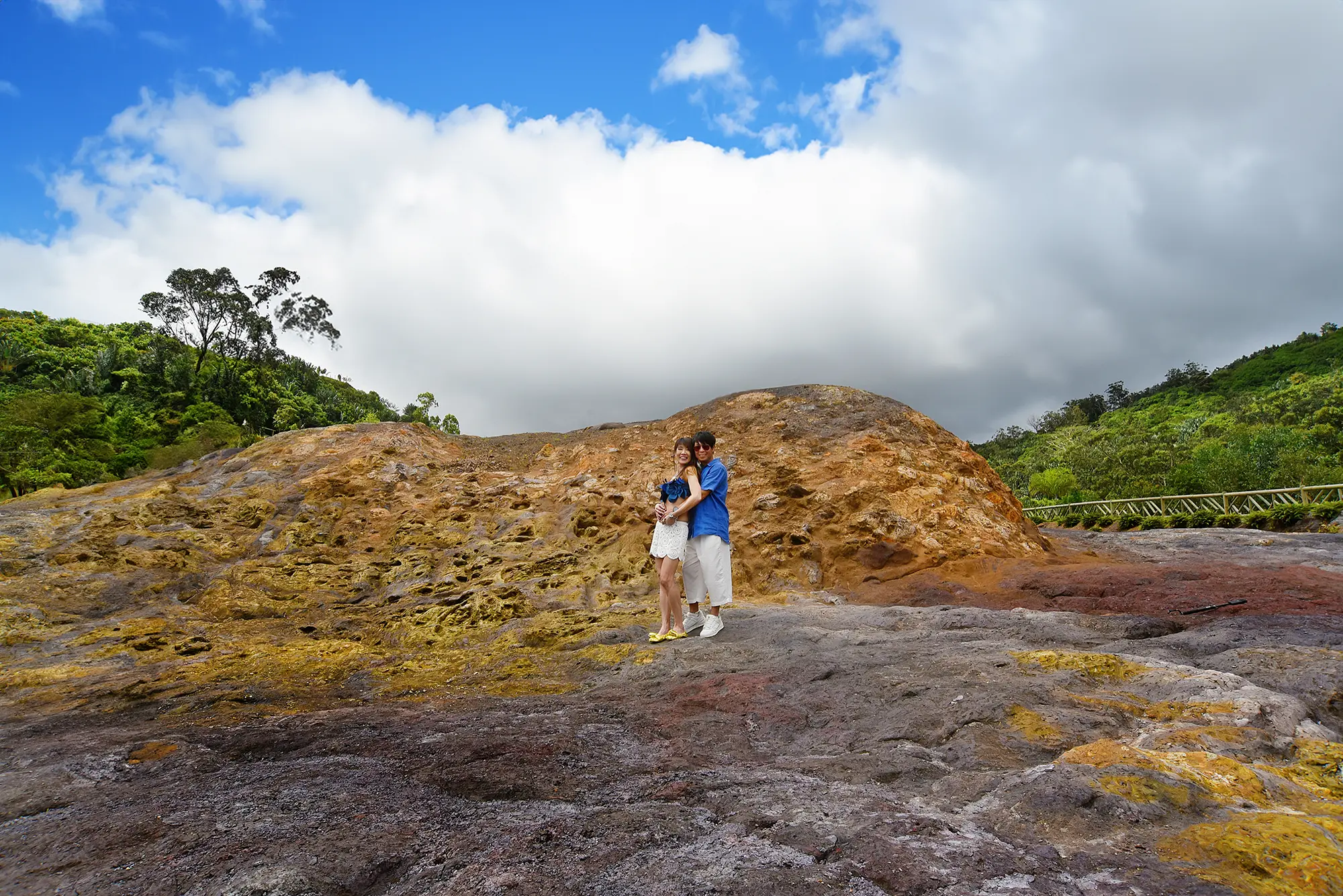
Photography in Chamarel
Chamarel offers four distinct photography positions — each produces a completely different type of image, and together they give a couple's gallery a visual variety that would take three or four other locations to replicate.
Position 1 — Seven Coloured Earth Viewpoint (8–9am)
Arrive at the site between 8am and 8:30am, before the first coach groups. The eastern morning light at this hour is low and directional, casting long shadows across the dune surfaces that emphasise the texture and depth of the colour bands. For couple photography, I position subjects on the viewpoint platform with the full sweep of the dunes behind them. The warm reds and browns of the earth create a background palette that is completely unlike anything available on the coast — earthy, ancient, otherworldly. Wide-angle environmental portraits work best here; the landscape needs to dominate the frame to communicate where you are.
Position 2 — Drone Above the Seven Coloured Earth (60m altitude)
A drone at approximately 60 metres altitude, directly above the centre of the dune field and angled at 45 degrees, produces the image that defines Chamarel photography. The seven colour zones are laid out below like a topographic map, and a couple positioned on the viewpoint platform appear as small figures against the vast coloured landscape. No ground-level camera can produce this perspective. I fly before 9:30am to avoid the period when the site is busiest and to keep the sun at a favourable angle. Wind conditions on the plateau can be variable — I check forecasts 24 hours in advance.
Position 3 — Couple Portraits in the Coloured Earth Landscape
The warm tonality of the Seven Coloured Earth — particularly the rust-red and deep brown zones — creates a natural colour palette that flatters almost every skin tone and outfit colour. A couple standing at the railing of the viewpoint, with the dunes receding behind them, has a backdrop that could not be more different from the usual beach portrait. For honeymoon and couple sessions, I use a medium telephoto (85mm or 135mm) to compress the background and bring the colours forward, making the dunes feel like they are right behind the subjects rather than 30 metres away. The warm earthy tones of Chamarel are particularly striking when the couple is wearing lighter colours — white, cream, pale blue — which contrast with the deep reds of the soil.
Position 4 — Waterfall Long Exposure from the Platform
From the waterfall observation platform, a long exposure (1/4 to 1 second, depending on flow rate) turns the cascade into a smooth white ribbon against the dark green of the gorge walls. For couple photography, I position subjects to one side of the frame with the falls in the background — the motion blur of the water creates a natural sense of energy and movement that complements the stillness of two people together. The mist that rises from the base of the falls occasionally reaches the platform level when the wind is right, creating a soft atmospheric haze that is beautiful in portraits.
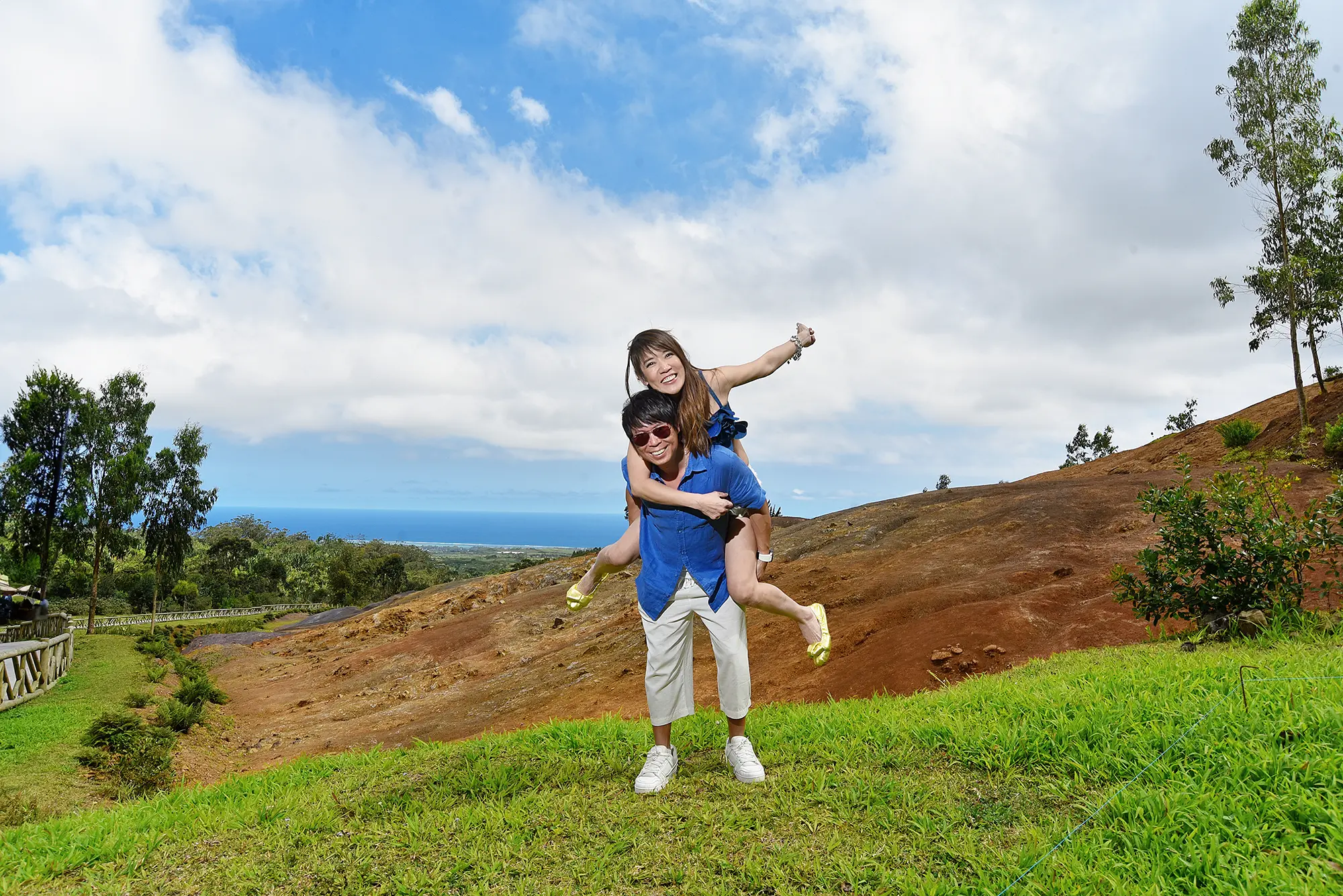
Chamarel Rum Distillery
Chamarel Rhumerie is the only single-estate rum in Mauritius — a distinction that matters. Every other rum produced in Mauritius uses sugar molasses bought from the large commercial sugar mills and blended at a separate facility. Chamarel grows its own sugarcane on the property, harvests it, presses it, ferments the fresh juice (not molasses — this is an agricultural rum in the French rhum agricole tradition), and distills it on site. The result is a rum with terroir — you can taste the soil, the rainfall pattern, the particular variety of cane grown on this specific plateau.
The guided tour runs approximately 45 minutes and covers the full cane-to-bottle process: the cane fields, the pressing and fermentation tanks, the still, the barrel ageing room, and finally the bottling line. The tour guide explains the difference between rhum agricole (from fresh cane juice) and traditional rum (from molasses) — a distinction that is genuinely interesting even if you are not a rum enthusiast. The distillery is clean, well-presented and designed for visitors; it is not a working industrial site that has been reluctantly opened to tourists.
The tasting session at the end of the tour is a proper 45-minute tasting of the Chamarel range. Signature expressions include: Extra Pure (the unaged white rum — fresh, grassy, the best expression of the raw terroir), Vanilla (infused with Mauritian vanilla pods — the best-selling expression and genuinely excellent), Coffee (made with local coffee, rich and dark), Aloe (unusual, clean and surprisingly drinkable), and Ylang Ylang (made with the flower used in Chanel No. 5 — floral and distinctive). Entry with tasting is approximately €20 per person. Bottles are available in the shop from €25.
For photography sessions that include the distillery, I photograph couples in the barrel ageing room (the warm amber tones of the wood and the low light make for beautiful images) and in the cane fields at the edge of the property if the harvest schedule allows access. The distillery is approximately 8 minutes from the Seven Coloured Earth by car.
Black River Gorges National Park
Black River Gorges National Park is the largest protected area in Mauritius — approximately 6,574 hectares of native forest, gorges and plateau grassland that forms the ecological core of the island. The main park entrance at Petrin is approximately 10 minutes below Chamarel village by car, descending from the plateau towards the coast. It is easy to combine both in the same day.
The park is the last stronghold of Mauritius's endemic birds — species that evolved on this island and nowhere else on earth. The most famous are the echo parakeet (Psittacula eques), which came to within 10 individuals of extinction in the 1980s and now numbers over 700 following one of the most successful bird conservation programmes in history, and the Mauritius pink pigeon (Nesoenas mayeri), another conservation success story. Both species are visible within the forest near the Petrin entrance.
The Vacoas Trail is the most accessible walking route for visitors without specialist equipment — a marked path through native forest that can be completed in 1–2 hours and gives a genuine sense of the endemic forest ecosystem. No guide is required for the Vacoas Trail. More demanding routes, including the descent into the gorge itself, require better footwear and ideally a guide — conditions can be slippery after rain, which is frequent at this altitude.
For photography, the park offers dramatic gorge viewpoints (particularly at the Gorge Viewpoint on the main Chamarel–Black River road), endemic forest interiors with dappled light, and open plateau grassland with views towards the south coast. I do not typically photograph couples deep inside the park — the terrain is challenging and the light under the forest canopy is difficult — but the gorge viewpoints and the entrance area are excellent for environmental portraits.
Getting There and Full Day Plan
Chamarel is in the Black River district of south-west Mauritius. There is no direct public bus from the main tourist areas — hire car, taxi or organised excursion are the practical options. From Le Morne the drive is approximately 45 minutes; from Grand Baie in the north approximately 1 hour.
The ideal full day built around Chamarel — which I have refined over years of guiding photography clients through this circuit — runs as follows:
- 6:00–8:00am — Le Morne sunrise photography: If you are staying in the south, start at Le Morne for sunrise. The light on the Le Morne Brabant mountain at dawn is extraordinary, and the lagoon is mirror-calm at this hour. A 90-minute shoot here before the wind picks up is the ideal start.
- 8:30–11:00am — Chamarel (Seven Coloured Earth + Waterfall): Arrive at the Seven Coloured Earth site by 8:30am, before coach groups arrive. Photograph the dunes in morning light, drone above the site, couple portraits at the viewpoint. Walk to the waterfall (15 min), photograph the cascade. Back to the car park by 11am at the latest.
- 11:00am–12:30pm — Chamarel Rhumerie (tour + tasting): 8 minutes by car from the Seven Coloured Earth. The tour runs approximately 45 minutes and the tasting another 45 minutes. This is a natural mid-morning pause — a chance to sit, taste, and let the heat of the day build before heading back out.
- 1:00–3:00pm — Black River Gorges National Park: Descend from Chamarel to the Petrin entrance (10 min). Walk the Vacoas Trail or explore the gorge viewpoints. Endemic bird sightings are most likely in the early afternoon when the birds are active after the midday quiet.
- 3:30pm — Return to hotel via coastal route: The coastal road from Black River back towards Le Morne or Flic en Flac is one of the most scenic drives in Mauritius — sugarcane fields meeting the Indian Ocean. Worth taking slowly.
Total driving time for the circuit: approximately 2 hours. Total time on the ground: 6–7 hours. This is a full but not exhausting day, and it covers four of the most distinctive experiences in Mauritius in a single well-structured itinerary.
Chamarel, Mauritius — FAQ
Capture Your Mauritius Memories
Chamarel from the air. Le Morne at sunset. Every Mauritius experience deserves to be photographed.