Sunrise at Belle Mare — A 6 AM Couple Session Where the Lagoon Is Glass
June 17, 2026 · By Bilaal Sadeer · 10 min read
Behind the scenes of an early-morning couple photoshoot at Belle Mare beach — what happens when you get there before the world wakes up, the lagoon is perfectly still, and you have exactly eight minutes of gold before the light changes forever.
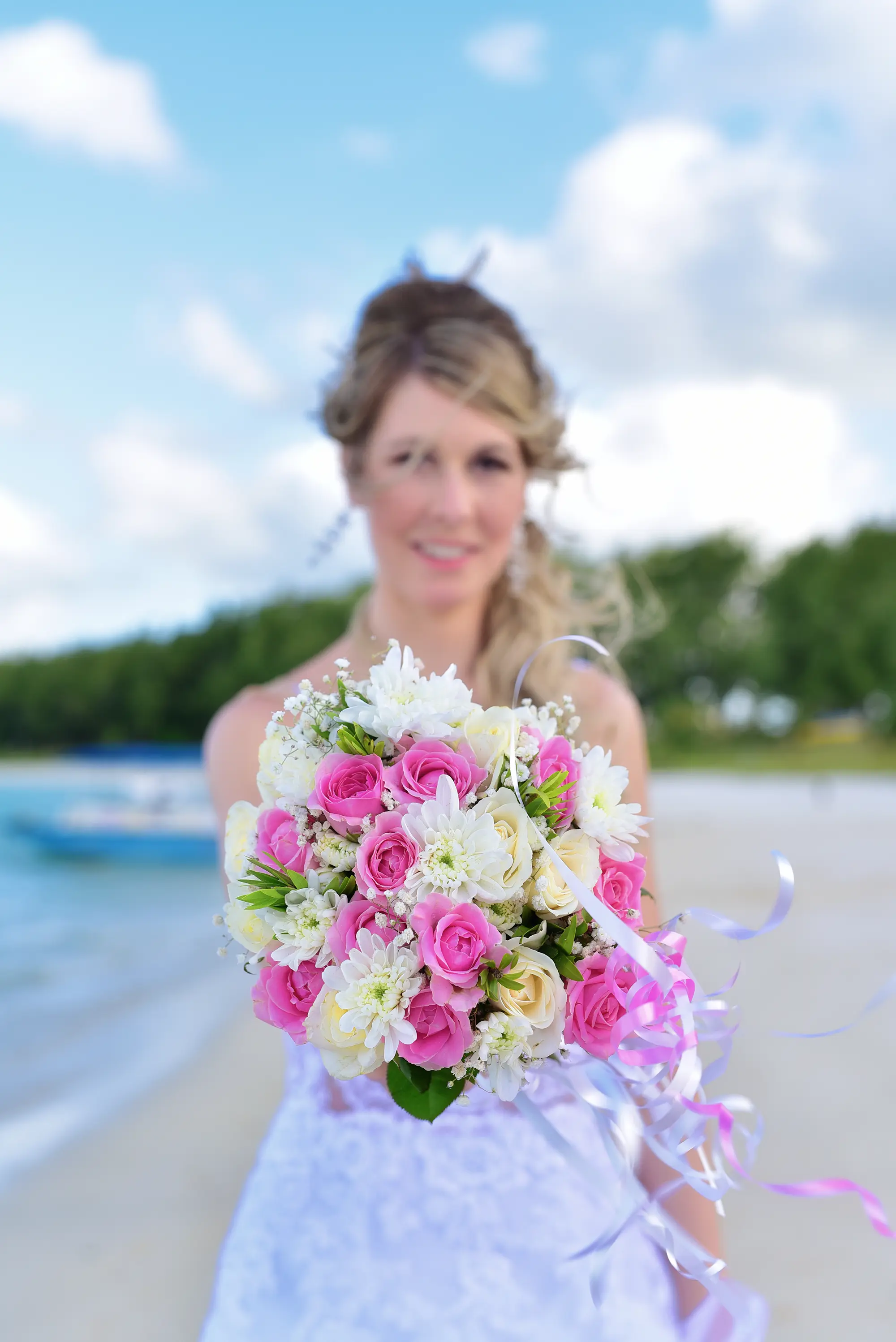
The Belle Mare Sunrise Shoot — Key Facts
- Location: Belle Mare beach, east coast of Mauritius — faces the Indian Ocean, first light on the island.
- Session start: 5:50am. Session end: 7:00am. Back at the hotel for breakfast by 7:30.
- Couple: Claire and Maxime, honeymooners from Paris, staying at Constance Belle Mare Plage.
- The golden window: 8 minutes after the sun clears the horizon. Glass-flat lagoon. Everything turns gold.
- Delivery: 3-day turnaround — they had the gallery before landing back in France.
- Why sunrise over sunset at Belle Mare: no wind, no crowds, mirror-calm water. Sunset here faces west — you lose the lagoon.
The 5am Alarm and the Drive North
The alarm goes at 5am. It is never a pleasant sound. But there is a particular quality to the darkness at that hour in Mauritius — cooler than you expect, the smell of the Indian Ocean already in the air even forty kilometres from the coast — that makes it easier to swing your legs out of bed than it has any right to be.
I had been shooting in the south the day before: a wedding at Heritage Le Telfair, a late evening reception, the drive back across the central plateau in the small hours. Four hours of sleep. The camera bags were already packed, which is a rule I have followed for fifteen years and will never break.
The drive from my home to Belle Mare takes about thirty-five minutes at that hour. The coastal road north through Rivière du Rempart is empty — the cane fields dark on both sides, the occasional security guard at a supermarket car park, the odd cat crossing the road with complete indifference to your headlights. By the time you reach the east coast and the road begins to follow the shoreline, the sky has started to show what is coming. Not light exactly — more like a slightly less definitive darkness. Navy, instead of black.
I almost always propose sunrise over sunset when couples ask me about Belle Mare. The reason is simple and I have tested it enough times to be confident: Belle Mare faces east. The lagoon here is protected by the reef, and in the morning — before the trade winds build — it lies absolutely flat. Mirror-flat. The kind of flat that makes you stop the car and just look. Sunset at Belle Mare is perfectly pleasant, but the beach faces away from the best light, and by 4pm the wind has usually picked up enough to put a chop on the water that works against the reflection shots I want. Sunrise is a different place entirely. Same sand, same reef, different planet.
Arrival: The Beach at 5:50am
I parked just north of the Constance property at 5:47am and walked down to the beach. The tide was mid — not fully in, not retreating, which gave me a wide band of wet sand that was essentially perfect. Wet sand at this time of morning does something extraordinary: it becomes a secondary sky. Everything that happens above the horizon happens again below your feet, in a slightly softer, slightly warmer version of itself.
The lagoon was glass. I mean that precisely — not figuratively. There was not a breath of wind. The water was so still that the palm trees on the far side of the beach were perfectly inverted in the surface, and the line between the water and the sky was almost impossible to identify. Looking out towards the reef, you could see the first edge of colour on the horizon — a deep rose, barely distinguishable from the grey-blue above it, running in a thin band from north to south.
The colour sequence at Belle Mare in the thirty minutes before and after sunrise is unlike anything I have seen at other Mauritius beaches. It begins as navy — the whole sky, deep and dense. Then, perhaps twenty minutes before the sun appears, the eastern horizon turns a saturated pink that would look absurd in a studio but is simply the truth of the place. That pink bleeds upward, softening as it rises, mixing into the remaining navy to produce a violet that lasts perhaps five minutes. Then the gold comes. When the sun clears the horizon, everything — the water, the wet sand, the couple standing in front of you — turns the colour of warm brass for approximately eight minutes. After that, the sun climbs quickly, the gold bleaches out to white, and you are in an ordinary morning.
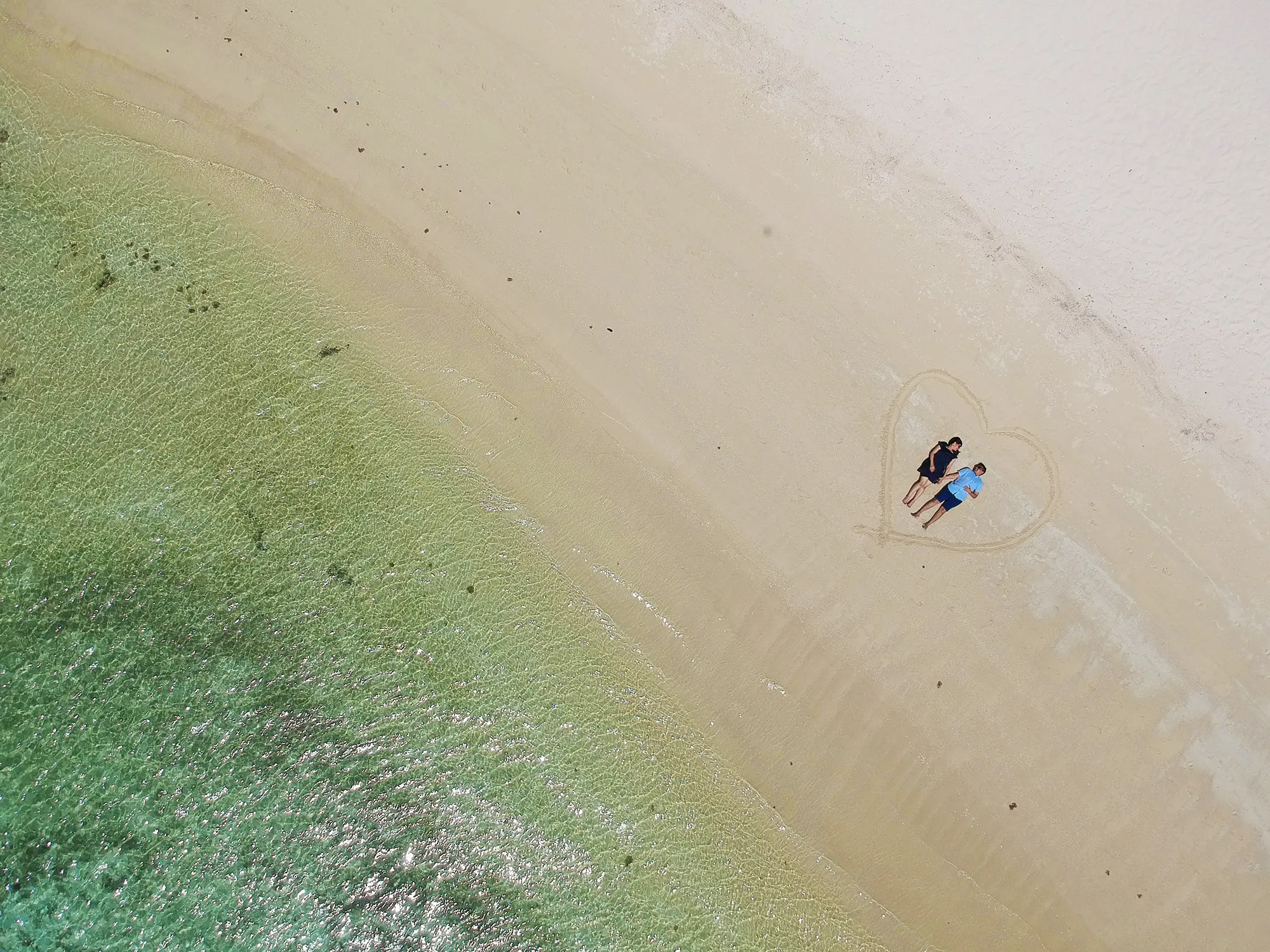
Those eight minutes are everything. The entire reason for the 5am alarm.
Meeting Claire and Maxime at the Gate
I had met Claire and Maxime three days earlier over WhatsApp. They had found me through a Google search — "photographe couple Belle Mare Maurice" — and their first message was in French, which made the conversation easier. They were staying at Constance Belle Mare Plage on their honeymoon: ten days, having married in Paris six weeks before. The wedding itself had been photographed by someone else. What they wanted from Mauritius was something different — not the formal portraits of the Paris wedding, but something that actually looked like the place they were in and the people they were with each other when no one was arranging them.
I suggested 6am. There was a pause in the WhatsApp thread.
"Six heures du matin?"
Yes. Six in the morning. The lagoon is glass. The light is gold. There will be no one else on the beach.
Another pause. Then: "D'accord. On essaie." We'll try it.
They appeared at the beach gate at 5:55am. I could tell from thirty metres that they had made a genuine effort, which I always appreciate — it is not nothing, to get dressed for photographs before the sun has risen. Claire was in a cream silk dress, thin-strapped, midi-length, bare feet already in hand rather than on her feet. Maxime was in a linen shirt the colour of oatmeal and white linen trousers, also bare feet. They both looked slightly dazed in the way that people who have set an alarm for 5:30am on a holiday look dazed. But they were there, and they were smiling.
I shook hands with Maxime, kissed cheeks with Claire in the French manner, and said: "Look at that lagoon." They both turned. Claire made a sound I cannot transcribe. Maxime just exhaled slowly. Neither of them said anything for a moment.
That is usually the moment I know the session is going to be good.
The First 20 Minutes — No Posing, Just Walking
My approach with couple sessions, especially with people who are not used to being photographed, is to do nothing for the first fifteen or twenty minutes except walk with them and talk. I do not direct. I do not pose. I keep the camera low and I let them figure out where their hands go and how close they stand to each other without someone watching them do it.
This sounds passive. It is not. I am watching everything — the way Maxime instinctively put his hand on the small of Claire's back when they stepped into the water for the first time, the way she turned slightly towards him when she laughed. These are not poses you can manufacture. They are the actual language of how two people who love each other move through space together, and they only appear when the person being photographed forgets they are being photographed.
We walked south along the water's edge, barefoot, the wet sand cool underfoot. The light was still in the pre-gold phase — that deep rose-violet, almost theatrical in its intensity. I was shooting wide, keeping them small in the frame against the expanse of the lagoon and the colour behind them. At this point the images are about place as much as people: this is Belle Mare, this is 6am, this is what it looks like when you are the only people on a beach in the Indian Ocean.
Somewhere in those first twenty minutes I made a frame I particularly love: their footprints in the wet sand, curving away from the camera, with the two of them small and slightly out of focus in the upper third of the frame, the lagoon stretching behind them. It is not a portrait — it is a document of the fact of them, together, in that place, at that hour. Claire told me later it was the image she printed first when she got home.
The Golden Window — Eight Minutes
At 6:13am, I watched the horizon. The pink had deepened to something almost orange. The violet above it had narrowed to a thin band. I said to Claire and Maxime: "It's coming. Walk towards the water and hold each other — don't look at me."
At 6:15am, the sun broke the horizon.
There are moments in this work where you stop thinking technically and simply react. The light that falls on Belle Mare in the first seconds after the sun clears the reef is the warmest light I have ever worked in. It is amber in a way that no filter can replicate because it is not a colour correction — it is the actual physical property of low-angle light passing through a longer column of atmosphere, scattering the blues and leaving only the reds and oranges. Everything turns gold. The cream silk of Claire's dress turned the colour of raw honey. Maxime's white linen trousers caught the same light and held it. The lagoon reflected all of it back upward in a sheet of warm metal.
I moved quickly. Wide angles first, catching them in the water with the reflection stretching towards the camera. Then closer — the way the light hit the side of Claire's face when she turned to look at Maxime. Then a few metres back, the two of them standing shin-deep, the surface of the lagoon so still that their reflection below them was almost more detailed than they were.
The window lasted eight minutes. I know because I checked the EXIF data later. At 6:23am, the sun had climbed enough that the quality of the light had shifted — still beautiful, but no longer that particular gold. The lagoon retained some of the warmth for another ten minutes, but the magic of the first moment was complete.
Eight minutes. I have had longer, on other mornings, at other beaches. But I have never felt the light at Belle Mare last longer than eight minutes in that first flush after sunrise. It is worth the alarm for every second of it.
The Lagoon, the Drone, and the Constance Cliff Line
After the golden window, the session shifted. The light was now brighter and more directional — still beautiful, but cooler. I used this phase for the drone.
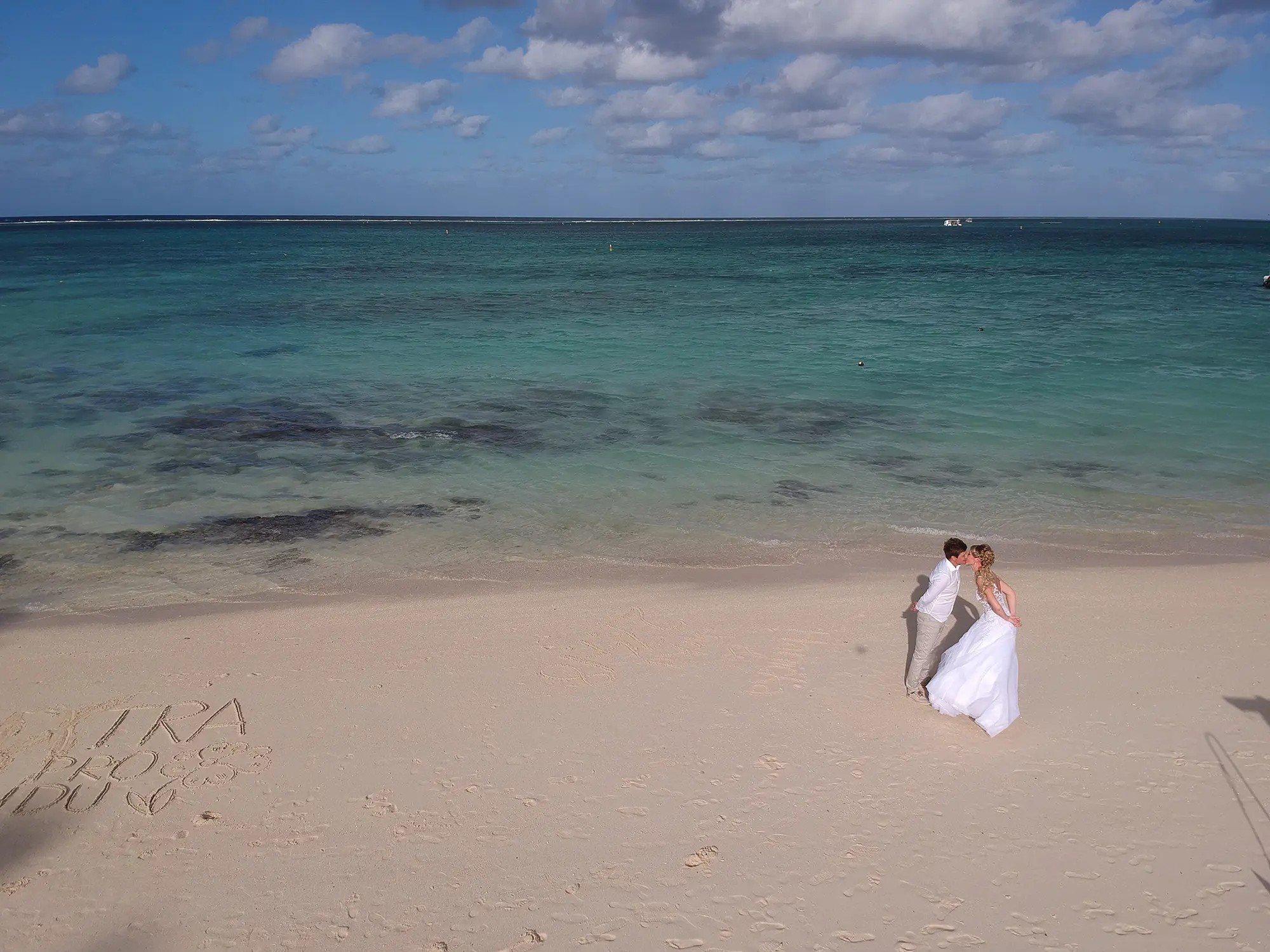
I asked Claire and Maxime to walk out to the sandbar — a shallow elevation in the lagoon floor about sixty metres from the beach, where the water drops to knee depth and you can stand in the middle of the lagoon as though suspended above it. They walked out together, hand in hand, and when they reached it I sent the drone up.
From forty metres, Belle Mare at 6:30am is extraordinary. The turquoise and cobalt of the lagoon, the white line of the reef, the dark blue of the open ocean beyond it. And in the centre of the frame, two small figures standing on a sandbar, holding each other, the water around them catching the sky. The aerial images from this session are among the strongest drone work I have done at Belle Mare, and I have shot this beach from the air more times than I can count.
Back on the ground, we worked along the southern stretch of the beach where the Constance property's low stone wall runs along the shoreline. The cliff line — or rather the gentle elevated line of the property's boundary planting — provides a natural framing device when you shoot from a low angle on the sand. Claire stood looking at Maxime with that line of green and warm stone behind her, the morning sky above it still holding some of the pink from earlier. It is one of my favourite compositional moves at this location: the couple in the immediate foreground, sharp; the Constance line as a mid-ground frame; the sky as the final layer above.
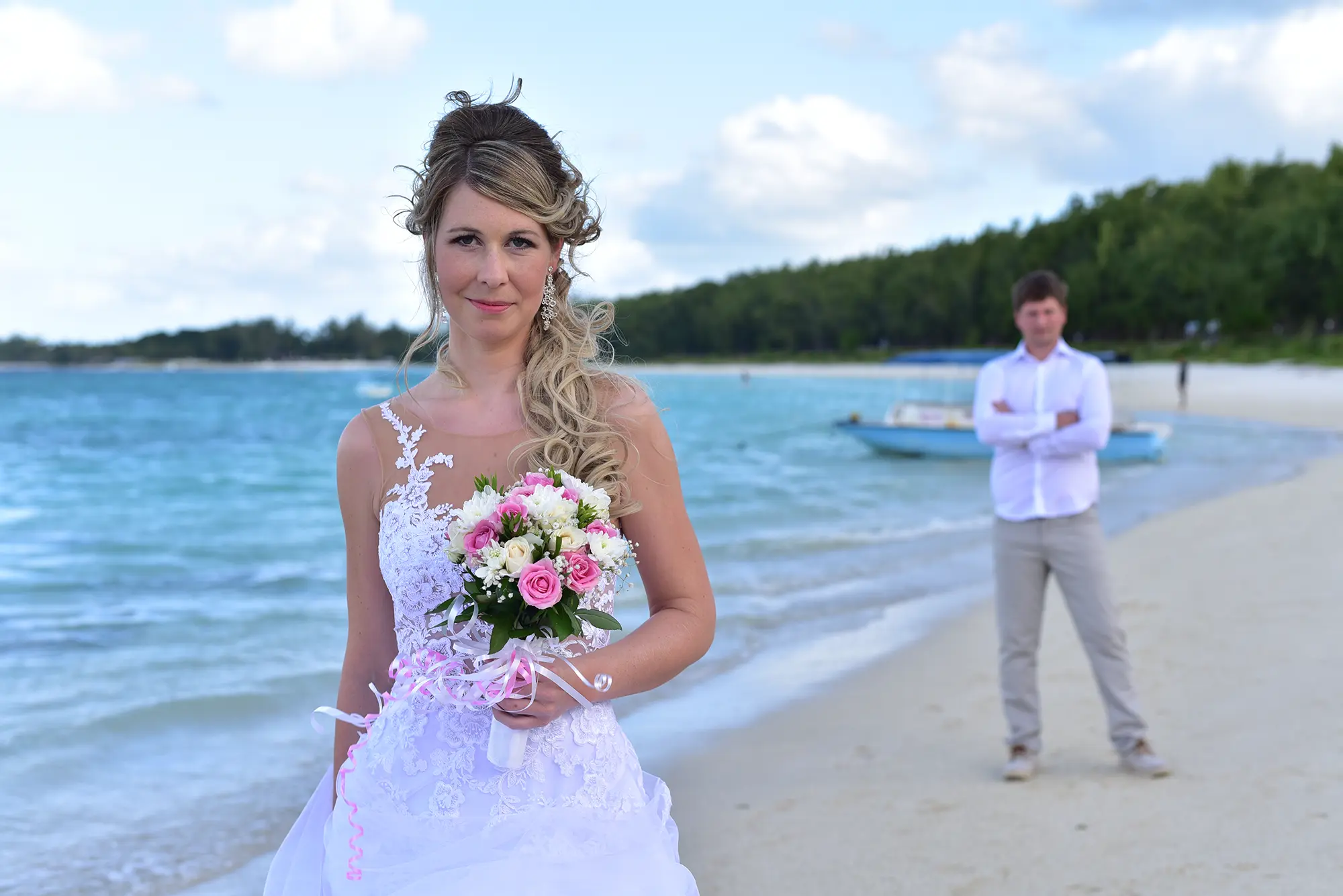
The last twenty minutes were the most relaxed. The pressure of the golden window was over, the drone was packed, and we simply made images without urgency. Claire had put her shoes back on — the sand was drying quickly now and starting to heat up, which told me exactly how close to 7am we were. Maxime had his arm around her. They were talking about breakfast.
7am — When the World Wakes Up
At exactly 7am, I became aware of three things simultaneously: the light had shifted to the flat, white quality of full morning; a resort employee had appeared on the beach a hundred metres to the south, beginning his daily setup of sun loungers; and a jogger had materialised at the northern end of the beach, running along the waterline with a pair of wireless earbuds and the slightly absent expression of a person who does this every day and has stopped noticing the view.
The session was over. Not because anything had failed — on the contrary, everything had gone exactly as it should. But the particular conditions that make a Belle Mare sunrise session what it is — the absolute solitude, the glass-flat water, the golden light — were now gone. What remained was a perfectly pleasant Mauritius morning, warm and beautiful, exactly what anyone photographs from any beach on any day. The rare thing had passed.
I packed the bags in about four minutes. Claire and Maxime were already talking about what they would order for breakfast. We walked back up the beach together, past the incoming sun loungers, through the resort gate. I shook hands with Maxime again and he said, very simply: "Merci. C'était magnifique." It was magnificent. It was. I agreed with him.
They were back in their room by 7:20am. I was in my car by 7:25am, driving back west with the sun now behind me, the cane fields beginning to show their green as the light reached them. I had over four hundred frames. That is a lot to select from — but it is also, for a session of this kind, exactly the right number.
The Gallery, the Flight Home, the Message from the Plane
I delivered the gallery two days later — within my standard three-day turnaround, but I had pushed it slightly because I knew Claire and Maxime were flying back to Paris on the third day and I wanted them to have it before they left. The final selection was 87 images: a mix of the wide environmental shots from the pre-gold phase, the portraits from the golden window, the aerial drone work, and the quieter close-up frames from the final thirty minutes.
The gallery went live at 11pm on their second-to-last night. I sent the link via WhatsApp. I did not hear back that evening, which is not unusual — people open galleries when they are ready, not when they receive the link, and sometimes the most emotional responses come the next morning when they have had time to sit with the images.
The response came at 14:37 the following day. The timestamp mattered: that was mid-afternoon Mauritius time, which put Claire and Maxime somewhere over the Arabian Sea, perhaps four hours out of Paris. They sent a message from the plane.
It said: "Bilaal — nous regardons les photos depuis une heure. On pleure. Merci infiniment." We have been looking at the photos for an hour. We are crying. Thank you infinitely.
I have been doing this work for fifteen years. That message — sent at altitude, somewhere over an ocean, from two people looking at images of themselves on a beach they were now flying away from — is the reason I do it. The photograph does not just record what happened. It gives you something to return to, from the plane, from Paris, from wherever you are when the morning at Belle Mare is six thousand kilometres behind you.
Three-day delivery means something for couples on short stays. It means the gallery is in your hands before the holiday ends, or at worst on the day you fly home. It means the images arrive while the feeling is still with you — while the sand is still between your toes, while you can still remember the exact quality of that eight-minute gold. By the time the feeling fades, the photographs are there to hold it.
Why 6am Is Not Too Early — What You Lose by Sleeping In
Almost every couple I suggest a sunrise session to has the same first reaction: that is very early. It is. 5:30am alarm on a holiday in a hotel where the breakfast does not begin until 7am and the pool will be warm by 10am. The rational case for staying in bed is not weak.
Here is what you lose by staying in bed at Belle Mare.
You lose the glass. By 8am, the trade winds have typically started, and the lagoon carries a small but definite chop. By 9am it is pronounced. The mirror-flat water that creates the reflection shots — the couple standing in the lagoon, their inverted image stretching towards the camera, the sky doubled in the surface at their feet — exists for perhaps ninety minutes after dawn. After that, it is gone until the following morning.
You lose the solitude. By 8am, the resort guests have started appearing on the beach: the early swimmers, the walkers, the snorkellers. By 9am, it is a populated public beach. There is nothing wrong with a populated public beach, but it is not the same as standing on empty white sand at 6am with only your partner and the Indian Ocean for company. That particular quality of being the only people in the world — or at least the only people on this stretch of coast — is a condition that expires with the sunrise.
You lose the colour. The pink and gold of the fifteen minutes before and after sunrise at Belle Mare is irreproducible by any other means. It is not something I can recreate at 5pm, regardless of how good the afternoon light is. It belongs to that hour and only that hour. The photographs it produces — the warm amber on skin, the rose tones in the water, the violet sky above the horizon — are categorically different from any other images I make on the same beach at any other time of day.
And you lose the cold. That sounds counterintuitive. But the coolness of the air at 6am, the fact that you are slightly underdressed, slightly uncertain, slightly outside your comfort zone in the best way — it produces a quality of aliveness in people that flat midday comfort does not. The images from early morning sessions have a particular energy. People are present in a way they sometimes are not when everything is easy.
Six in the morning at Belle Mare is not too early. It is exactly early enough.
If you are planning a couple shoot or honeymoon session on the east coast of Mauritius, I will almost certainly suggest we start at dawn. You can always go back to sleep after breakfast. You cannot recreate the lagoon when it was glass.
Belle Mare Sunrise Shoot — FAQ
Capture Your Mauritius Memories
Drone aerials. Golden-hour portraits. The turquoise lagoon as your backdrop. 15 years shooting Mauritius's most beautiful beaches.