20 Best Instagram Spots in Mauritius — A Photographer's Location Guide
Last updated: June 2026 · By Bilaal Sadeer
I have been photographing Mauritius professionally for 15 years. I have shot at sunrise from Belle Mare, flown a drone above Le Morne's underwater waterfall, waited in the dark at Cap Malheureux for the red church to catch the first morning light, and stood knee-deep in the Chamarel volcanic dunes at golden hour. This guide is not assembled from a tourist list — every single spot here is one I have personally photographed, multiple times, across every season and every time of day. What follows is the honest, location-specific answer to the question I am asked more than any other: where exactly should I take photos in Mauritius?
Mauritius Photography Zones — Key Facts
- Mauritius has 5 distinct photography zones: north (Cap Malheureux red church), east (Belle Mare sunrise), south-west (Le Morne UNESCO cliff), west (Flic en Flac sunset), central (Seven Coloured Earth).
- Each zone contains 3–5 hero shots that no other location in the world can replicate.
- Best golden hour — west coast: sunset 90 minutes before dark; east coast: sunrise from 5:30am.
- Drone rules: no permit needed for personal use under 25 kg; restricted zones near airports and military areas.
- Book a photographer 2–3 months ahead for peak season (June–December) to secure the best light windows.
- Photography sessions with drone start from €160 per hour — unlimited photos, 3 working days delivery.
How I Chose These 20 Spots
After 15 years of photographing Mauritius professionally — weddings, honeymoons, editorial commissions, drone surveys — I have developed a clear and somewhat ruthless set of criteria for what makes a location genuinely worth shooting. It is not about fame. Some of the most-photographed spots in Mauritius are, frankly, disappointing in practice: overrun with tourists, positioned incorrectly relative to the sun, or simply better as experiences than as photographs. Others that barely appear on tourist itineraries produce extraordinary images.
My four criteria are these. First: photographic originality — does this location produce an image that could only have been made in Mauritius? Cap Malheureux passes immediately. A generic beach shot, however pretty in person, does not make this list. Second: overcrowding vs. reward — is the crowd level proportionate to the photographic result? Île aux Cerfs is busy but the images justify it; Caudan Waterfront does not make the cut. Third: practicalityfor couples and individuals — can the shot be achieved without specialist access or impossible logistics? Fourth: time-of-day specificity — every spot on this list has a clearly defined window when it is at its photographic best. I give you that window. Going to the right place at the wrong time is one of the most common mistakes I see.
The result is 20 locations spread across all five photography zones of the island, covering every style from architectural heritage to drone aerials, from jungle waterfalls to mirror-flat lagoons. I have personally photographed every single one of them.
North Mauritius — 5 Instagram Spots
The north is the most visited part of Mauritius for good reason: the lagoon here is the clearest and most photographically consistent on the island, and the density of distinct subject matter — church, lighthouse, beach, market, offshore island — within a 20-minute drive is unmatched anywhere else.
1. Cap Malheureux Red Church
This is the single most iconic photograph in Mauritius, and it earns its status. Notre-Dame Auxiliatrice — a small 19th-century Catholic church with a vivid red roof and white walls — sits at the northernmost tip of the island, directly on the waterfront. Behind it, across a narrow channel of extraordinary turquoise water, the volcanic silhouette of Coin de Mire island rises from the sea. The combination — red architecture, white walls, turquoise water, dark volcanic island, blue sky — is unlike anything else on earth.
The shot: arrive at 7am. The light falls directly on the red tiles from the east at this hour, before the sun climbs and creates harsh shadows. Shoot from the beach to the east of the church, low angle, wide lens. For drone: fly approximately 40 metres, position the church in the lower third with Coin de Mire centred in the background. Do not arrive after 10am — by mid-morning the church is surrounded by tourist coaches and the light is overhead and flat.
2. Pointe aux Canonniers Lighthouse
A colonial-era lighthouse sitting on a low cliff above the lagoon at Pointe aux Canonniers, approximately 10 minutes west of Grand Baie. The lighthouse itself is not tall — it is the combination of the weathered stone structure, the cliffside vegetation, and the lagoon below that makes it work photographically. Shoot from the cliff path heading south. Best in early morning (7–9am) when the light is lateral and warm. The lighthouse is at its best in close-to-overcast conditions when the sky is interesting without being too dramatic; on a perfect blue-sky day it can look flat.
3. Trou aux Biches Public Beach
The public beach at Trou aux Biches is the definitive Mauritius lagoon photograph. The water here is a precise shade of cyan-to-turquoise that I have not seen reproduced at any other beach on the island — a function of the reef geometry, the sand composition, and the angle of light. The beach is widest in the morning. Shoot facing south from the northern end of the public beach; the palms frame the shot naturally. Best from 8–11am. For couples: wade into the water to the knee and shoot back toward the beach — the colour saturation at low angle is extraordinary. Bring polarising filter if shooting stills.
4. Île Plate from the Boat
Île Plate (Flat Island) is an uninhabited island approximately 20 km off the north coast of Mauritius, reachable by catamaran day-trip from Grand Baie (2–3 hours). The island itself is photogenic — a low, flat silhouette of scrub and white sand surrounded by reef — but the most compelling images are made from the boat on approach: the island as a thin strip of green and white against the open Indian Ocean, with no other land visible in any direction. Drone from the boat as you arrive: the aerial view of the reef structure around Île Plate and the colour gradient from deep blue to turquoise to white sand is world-class. Best on morning departures when the light is behind you heading north.
5. Grand Baie Sunday Market
The weekly Sunday market at Grand Baie is the only spot on this list that is purely about colour, texture and human life rather than landscape. The produce stalls — pyramids of tropical fruit, fish on ice, bolts of fabric in every colour, street food — offer an entirely different category of Instagram shot: vivid, layered, full of life. Arrive by 7am before the crowds thin the atmosphere. The light between the market stalls in early morning creates natural leading lines and dramatic shadows. Shoot at f/2.8 to isolate textures, or wide at f/8 to capture the full spectacle of the scene.
East Mauritius — 5 Instagram Spots
The east coast is where I send every serious photographer for their first morning in Mauritius. The sunrise light here is the best on the island, the lagoon is the largest, and the combination of empty beaches, heritage architecture and offshore islands within a single zone makes it the most photographically diverse stretch of coastline in Mauritius.
6. Belle Mare Lagoon at Sunrise
This is, without qualification, the best light in Mauritius. Belle Mare faces directly east. At sunrise — which falls between 5:30am and 6:15am depending on the season — the first light comes low across the water from exactly the right angle, turning the lagoon into a sheet of warm amber glass before the wind picks up and breaks the surface. The beach is wide, white and completely empty at this hour. No other location on the island gives you this combination: perfect light direction, mirror-calm water, white sand, zero crowds, palm fringe to the north. This is the shot that justifies waking at 5am. I have shot it more than 200 times and it is different every single morning.
7. Île aux Cerfs
The famous private-feeling island off Trou d'Eau Douce is reached by a 10-minute ferry from the mainland. The north beach of Île aux Cerfs gives you the classic postcard shot: white sand that curves into a calm turquoise bay, with the silhouette of the Touessrok resort visible across the channel as an architectural counterpoint. The crowd reality: the island is busy from 10am onwards. Take the first ferry at 8:30am, walk directly to the north beach, and you have 45–60 minutes before the day-trippers arrive. Drone shots from above the north beach — looking south toward the main island with the bay in the foreground — are among the most shared Mauritius images on Instagram for good reason.
8. Trou d'Eau Douce Village Pier
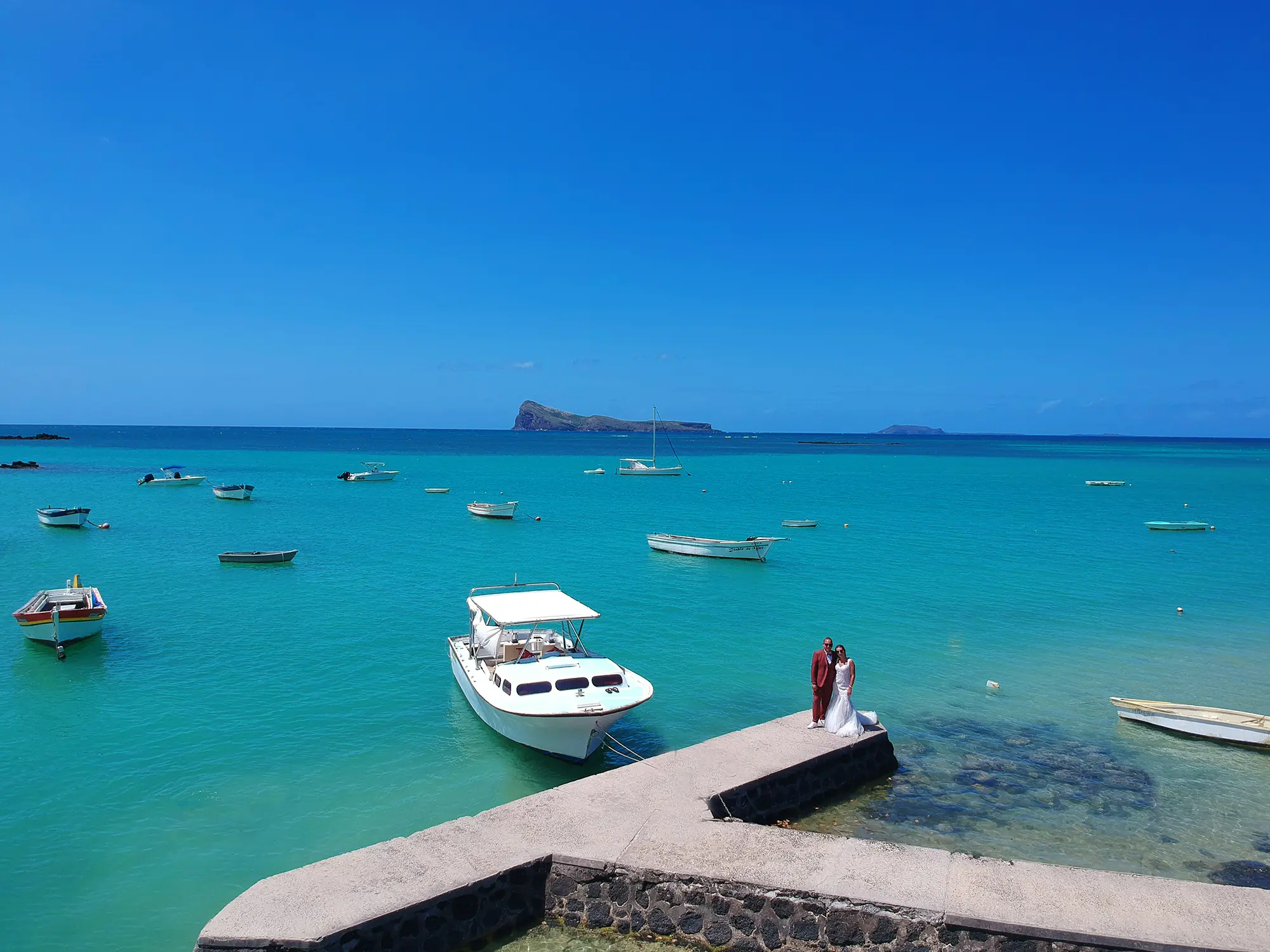
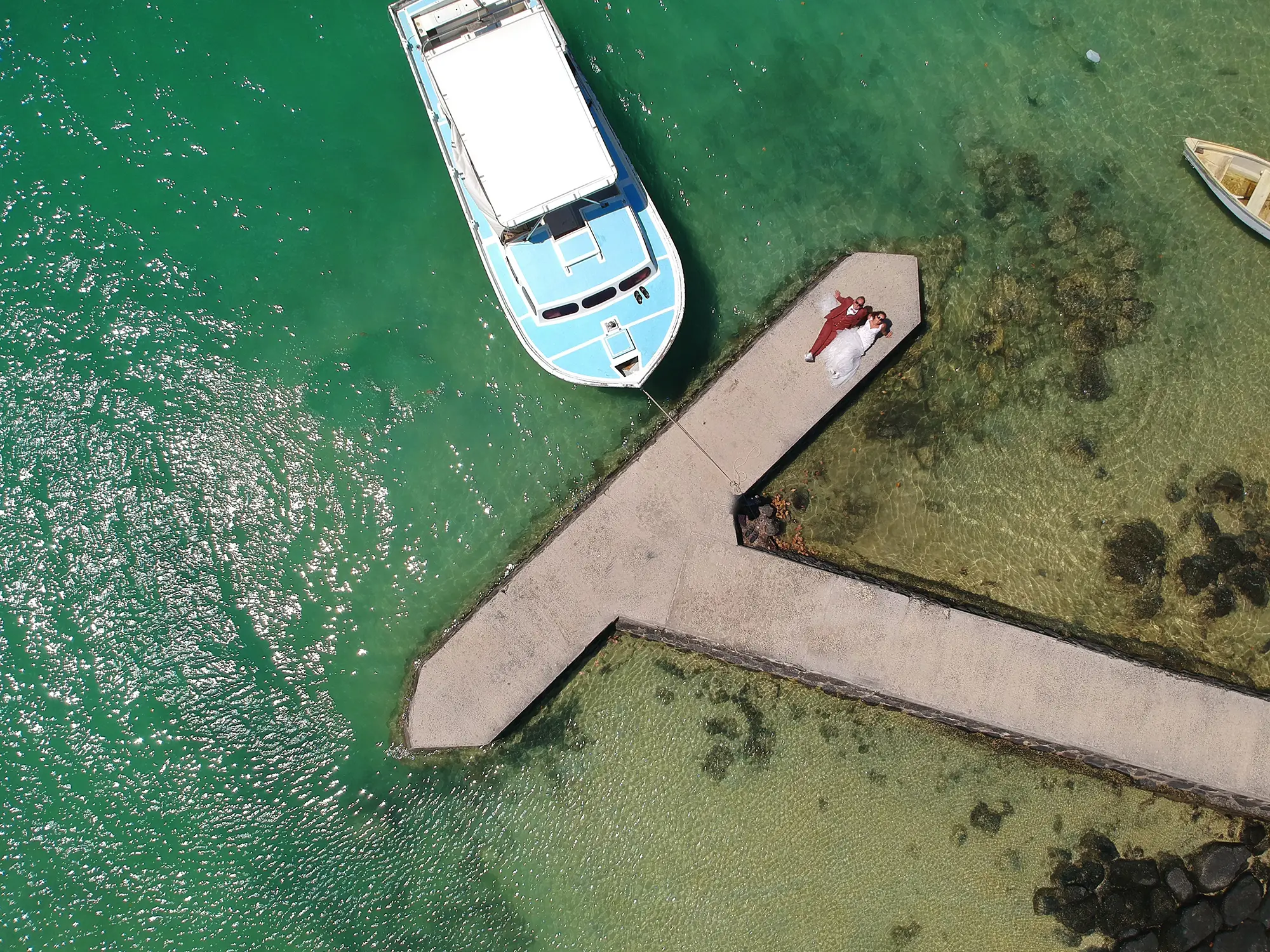
The village pier at Trou d'Eau Douce is one of the most underrated photography spots on the island. Wooden fishing boats in various states of painted and weathered colour are moored along the pier from early morning; their reflections in the calm harbour water create a layered composition of colour and geometry that has nothing to do with the classic turquoise-lagoon Mauritius image. This is local life photography. Best from 6:30–8:30am when fishermen are returning from night trips and the light is lateral. Telephoto lens (70–200mm) for isolated boat portraits; wide angle for the full pier-and-village composition.
9. Pointe de Flacq Lighthouse
The lighthouse at Pointe de Flacq stands on a dramatic rocky promontory on the east coast, approximately 20 minutes north of Belle Mare. The cliff setting is more exposed and angular than Pointe aux Canonniers in the north — the rocks here are jagged black basalt, and the ocean breaks against them with genuine force. The combination of the lighthouse, the black rocks, and the open Indian Ocean behind it creates a far more dramatic image than the calmer north coast equivalent. Best at any time of day — this location works in morning light, overcast conditions, and particularly well in the late afternoon when the low western sun catches the lighthouse face. A drone at 30 metres gives an extraordinary perspective on the cliff geometry.
10. L'Aventure du Sucre Sugar Museum
The heritage sugar factory at Pamplemousses, converted into a museum about Mauritius's 350-year sugar history, offers a category of Instagram shot that the beaches cannot: industrial heritage, colonial architecture, and extraordinary texture. The museum's exterior — a 19th-century factory building in weathered stone — is the primary photography subject. Inside, the machinery, the signage and the warm orange tones of the restored interior are compelling. Best in morning light (9–11am) when the stone facade is illuminated from the east. The gardens surrounding the museum, adjoining the Sir Seewoosagur Ramgoolam Botanical Garden, extend the photography options considerably.
South-West Mauritius — 5 Instagram Spots
The south-west is the most dramatically photogenic region of Mauritius. The UNESCO World Heritage Le Morne cliff, the world-famous underwater waterfall optical illusion, the volcanic dunes of Chamarel, the jungle waterfall, and the panoramic gorge viewpoint — this is the zone that produces the most globally shared images of Mauritius. It is also the most logistically demanding; I always allocate a full day for this region.
11. Le Morne Cliff + Lagoon
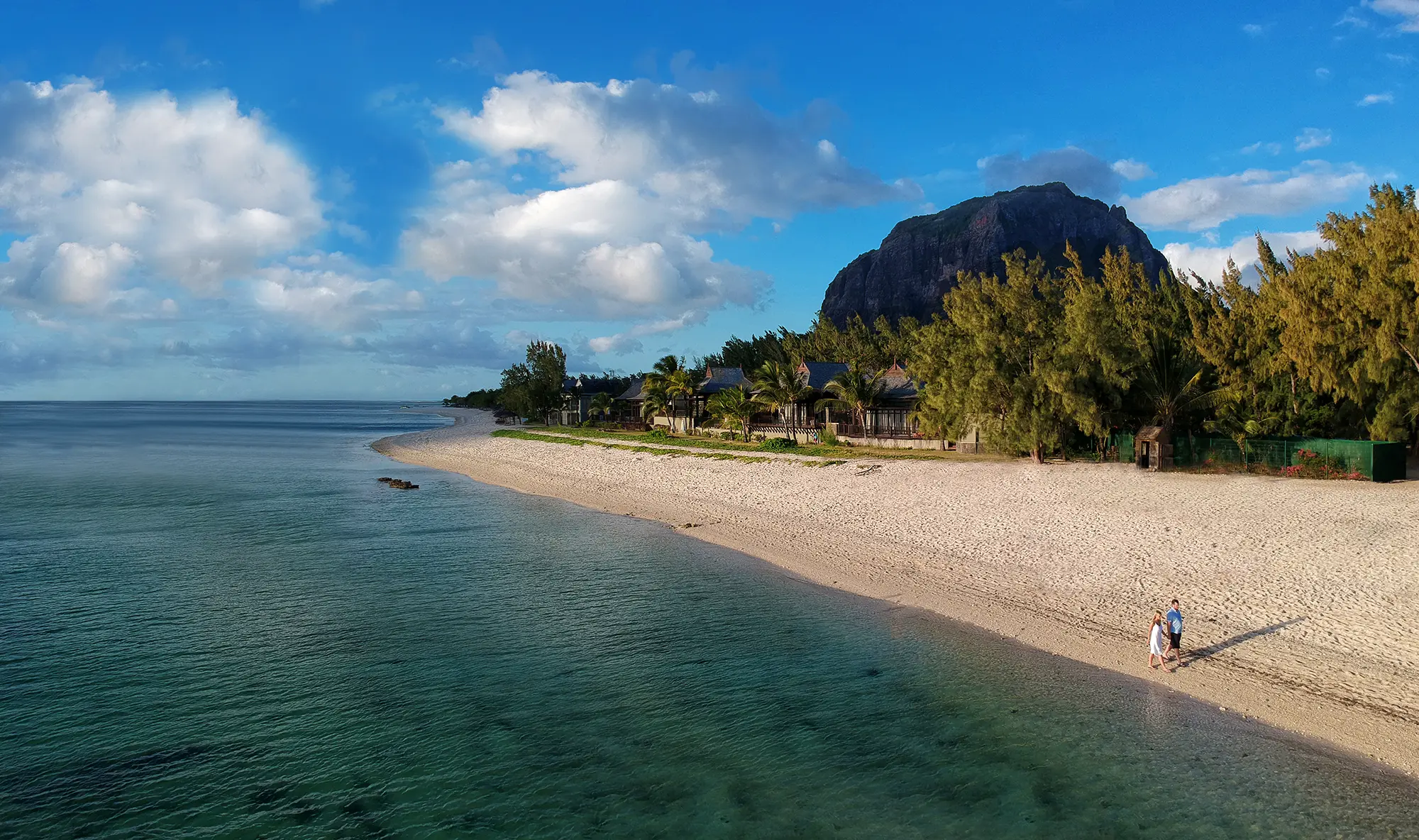
Le Morne Brabant is a UNESCO World Heritage basalt monolith rising 556 metres from the south-western tip of Mauritius. The combination of the cliff face, the turquoise lagoon stretching to the left, and the open Indian Ocean to the right creates the most dramatically composed landscape photograph in Mauritius. From the ground — specifically from the beach at Le Morne village looking north-east — the cliff dominates the entire frame. From the air, the geometry becomes even more extraordinary: the reef line traces a perfect arc from the cliff base eastward, separating the deep blue ocean from the shallow turquoise lagoon. Best at golden hour (90 minutes before sunset, west-facing) when the cliff face glows amber. Drone at 80 metres looking toward the cliff base gives the classic aerial composition.
12. Le Morne Underwater Waterfall from Drone
This is the image that more people contact me about than any other in my portfolio. The optical illusion of a waterfall plunging from the lagoon into a deep ocean abyss is created by sand and silt deposits that cascade off the shelf beyond the reef, visible only from directly above. To capture it, you need a drone, clear skies, and a position approximately 1–2 km south-west of Le Morne at an altitude of 60–80 metres. The effect is most pronounced in mid-morning light (9–11am) when the sun angle provides enough depth to the colour gradient. This is one of the most shared drone images on Instagram globally — and yes, it genuinely looks exactly like a waterfall. The optical illusion is perfect from the right altitude.
13. Seven Coloured Earth, Chamarel
The volcanic sand dunes of Chamarel are unique on earth: seven distinct colours of soil — red, brown, violet, green, blue, purple and yellow — created by differential cooling of volcanic basalt, arranged in undulating dunes that hold their colour distinction despite heavy tropical rainfall. The site is small — approximately 7,500 square metres — but the colour contrast from above is extraordinary. Ground-level photography works from the viewing platform; drone photography from 40–50 metres gives the full pattern. Best in morning light (8–11am) before the midday heat creates atmospheric haze that softens the colour contrast. Overcast conditions actually work well here — soft light reveals the colour differences more distinctly than direct sun.
14. Chamarel Waterfall
The Chamarel Waterfall — one of the highest single-drop waterfalls in Mauritius at approximately 100 metres — plunges into a gorge of extraordinary lush green jungle in the Chamarel region. The viewpoint is easily accessible from the road; the full waterfall is visible from the official viewing platform. For a wider composition that includes the gorge and the jungle canopy, position yourself on the left side of the platform. Best after rainfall — the waterfall volume increases dramatically after even moderate rain, and the surrounding jungle is at its most saturated green. Morning light (9–11am) catches the waterfall face; afternoon light loses the water in shadow. A drone at low altitude over the gorge gives a perspective no ground-level shot can achieve.
15. Black River Gorges Viewpoint
The panoramic viewpoint above the Black River Gorges National Park on the south-western plateau gives the widest view in Mauritius: the gorge system drops away into dense native forest, and on a clear day the coast — the Le Morne peninsula, the lagoon, and the Indian Ocean — is visible as a thin blue-and-turquoise stripe on the horizon 15 km away. This is not a single-subject shot; it is a grand landscape. Best in early morning (7–9am) before cloud builds over the plateau. The viewpoint car park is small; arrive before 8am on weekends.
West Mauritius — 3 Instagram Spots
The west coast is where I spend most of my golden-hour sessions. The sun sets directly over the Indian Ocean horizon here — no land, no clouds (most evenings), just an unobstructed western horizon that turns every shade of amber, crimson and purple in the 90 minutes before dark. The three spots below each offer a different foreground against that sunset backdrop.
16. Flic en Flac Sunset from Centre Beach
The public beach at the centre of Flic en Flac — the stretch running south from the village — is the definitive west coast sunset location. The beach faces directly west, the sand is wide and pale, and at golden hour the water goes from turquoise to gold to deep amber in the space of 30 minutes. For couples: wade to the knee at low tide and shoot back east toward the darkening sky with the sunset behind the photographer — this creates the classic silhouette-with-golden-reflection image. Arrive 90 minutes before sunset, position by 45 minutes before, shoot through to 10 minutes after the sun has fully set (the afterglow is often the best light of all).
17. La Balise Marina, Black River
La Balise Marina at Black River (Rivière Noire) is the most architecturally interesting marina in Mauritius — a collection of coloured fishing and leisure boats, wooden pontoons, waterfront cafes, and the mountains of the Black River region as a backdrop. At golden hour the boats cast long reflections across the still marina water; the combination of warm light, reflected colour, and mountain silhouette is unique to this location. Best from 90 minutes before sunset. A drone at 20–30 metres looking down along the marina pontoons gives an extraordinary pattern of boats, colour and reflection.
18. Tamarin Bay Morning
Tamarin Bay on the west coast is known for its resident dolphins, its surfing break, and its black volcanic sand — all three of which contribute to a completely different visual character from the white-sand northern and eastern beaches. In the morning (6–9am), the spinner dolphins come inshore to feed; from the beach or from a drone you can capture them riding the surf break. The surfers, the dolphins, and the dark volcanic sand against the morning light create an image that could not be made anywhere else in Mauritius. The bay is also framed by the Black River mountains to the south, providing a dramatic backdrop for wide landscape shots.
Bonus Central Mauritius — 2 Heritage Spots
The central plateau and southern interior of Mauritius offer a different category of photograph entirely: colonial heritage architecture, hilltop chapels, and panoramic views over the southern coast. These two spots are consistently overlooked by visitors focused on the coast but produce images that stand out precisely because they look unlike everything else in a typical Mauritius gallery.
19. Eureka Colonial House, Moka
Eureka is a 19th-century colonial Creole house in the Moka valley with 109 rooms, wide verandas, a river garden, and a level of architectural preservation that is rare anywhere in the Indian Ocean. The house sits in a valley of tree ferns and tropical garden; the building itself — pale yellow rendered walls, dark shuttered windows, wrap-around veranda — is the perfect subject for a heritage editorial shoot. Best in morning light (8–10am) when the valley is still cool and the light comes laterally across the veranda. The gardens to the rear, beside the river, offer a completely separate set of compositions. For couples wanting a heritage rather than beach context for their Mauritius photographs, Eureka is the only property on the island that delivers this at this level.
20. Notre-Dame de Lourdes Chapel, Savanne
A small Catholic chapel on a hilltop in the Savanne district of south Mauritius, Notre-Dame de Lourdes sits above a panoramic view of the south coast that stretches from the mountains to the Indian Ocean horizon. The chapel itself — white rendered walls, modest architecture — is less visually remarkable than Cap Malheureux, but the combination of the hilltop position, the panoramic southern view, and the completely isolated setting creates a different kind of image: quiet, spiritual, and compositionally open. Best in morning light when the south coast is lit from the east. Accessible by road from the Savanne district; the final approach is a rough track. Drone at 60 metres over the chapel looking south gives the full panoramic view of the south coast.
Pro Tips for Each Time of Day
The single most important decision you make as a photographer in Mauritius is what time of day to be at which location. The wrong time makes even the best spot mediocre. Here is how I structure the day across all five zones.
Sunrise (5:30–7:00am) — East Coast
This is the most important window of the day. Belle Mare and Trou d'Eau Douce face directly east; at 5:30am the first light comes in low, warm and directional across the mirror-flat lagoon. By 7am the light is already climbing and losing its warmth. Set your alarm for 4:45am, be on the beach by 5:20am, and shoot until 6:30am. You will have the entire beach to yourself and light conditions that no other time of day can provide. This window is worth three hours of afternoon shooting.
Morning (7:00–11:00am) — Architecture, Interiors, Markets
After the sunrise window, move to subjects that benefit from lateral morning light: Cap Malheureux red church (7–9am), Grand Baie Sunday market (7–9am on Sundays), Seven Coloured Earth at Chamarel (8–10am), and the colonial interior of Eureka or L'Aventure du Sucre (9–11am). The morning window is also when the Chamarel region is at its clearest before midday cloud builds over the plateau.
Afternoon (11:00am–3:00pm) — Avoid for Most Locations
I do not schedule outdoor portrait shoots between 11am and 3pm. The midday sun in Mauritius is directly overhead and harsh — it creates unflattering shadows on faces, bleaches colour from water, and makes landscape photography flat. Use this time for lunch, travel between zones, research, or rest before the golden-hour session. The exceptions are underwater photography (light penetrates better at midday) and shaded interior locations such as museums and colonial houses.
Golden Hour (3:00–6:30pm) — West Coast
The 90-minute window before sunset on the west coast is the premium photography slot of the day for couples and portrait work. Flic en Flac, La Balise Marina, Le Morne beach, and Tamarin Bay all face west or south-west. The sun descends to the horizon without obstruction and turns the entire Indian Ocean into amber light. I arrive 90 minutes before sunset, position the couple with their backs to the sun for the first 45 minutes (backlit, halo effect), then turn them to face the sunset for the final 45 minutes (warm front light). After the sun drops below the horizon, shoot for a further 10–15 minutes into the afterglow — often the most beautiful light of the entire session.
Drone Windows — Morning Calm and Low Wind
Drone photography in Mauritius has two reliable windows. The first is the early morning (6–9am) when the trade wind has not yet built — wind at this hour is typically 5–10 km/h across most of the island. The second window is the late afternoon (4–5:30pm) when the afternoon sea breeze drops before the evening wind builds. Avoid midday drone flying: the thermal activity above the plateau creates unpredictable updrafts, and the flat overhead light makes aerial photography unrewarding. The Le Morne underwater waterfall is an exception — it requires specific sun angle (morning, mid-sun) to show the colour gradient clearly.
Mauritius Instagram Spots — FAQ
Capture Your Mauritius Memories
€160 for the first hour. Drone always included. Unlimited photos. 3 working days. No hidden costs.