Flic en Flac — Sunsets, Beach & Photography
Last updated: June 2026 · By Bilaal Sadeer
Flic en Flac is the west coast's defining beach — 8km of white sand that faces due west, so the sun drops clean into the Indian Ocean horizon at the end of every single day. No reef island in the way, no east-coast headland to cut the light. Just the full colour arc from gold to crimson to purple reflected across a warm, sheltered lagoon. I have been shooting sunsets here for 15 years, and I still arrive early. This guide covers everything: the best photography positions, the five-star hotels directly on the beach, the diving, the village restaurants and exactly how to get there from anywhere on the island.
Flic en Flac — Key Facts
- 8km of white sand — the longest continuous beach strip on the west coast.
- West-facing aspect: the only major beach on the island where the sun sets directly over the open sea with no obstruction.
- Warm lagoon protected by a barrier reef — water temperature 26–29°C year-round.
- Relaxed village atmosphere: restaurants, bars, bakeries, dive shops co-exist alongside the resort strip.
- Hotels: Sugar Beach, Maradiva Villas, Sofitel Imperial, Club Med.
- 40 minutes from Port Louis · 1 hour from Grand Baie · 1 hour from the airport.
Why Flic en Flac Has the Best Sunset on the Island
The geography of Mauritius is decisive here. The island's east coast faces the open Indian Ocean — which means glorious morning light, mirror-calm lagoons and spectacular sunrises, but the sun arcs away to the west and is gone from view by late afternoon. By 17:00 in winter, east coast beaches are already in the shadow of the island's central plateau. The sunset you are watching from Belle Mare or Trou d'Eau Douce is happening somewhere behind you.
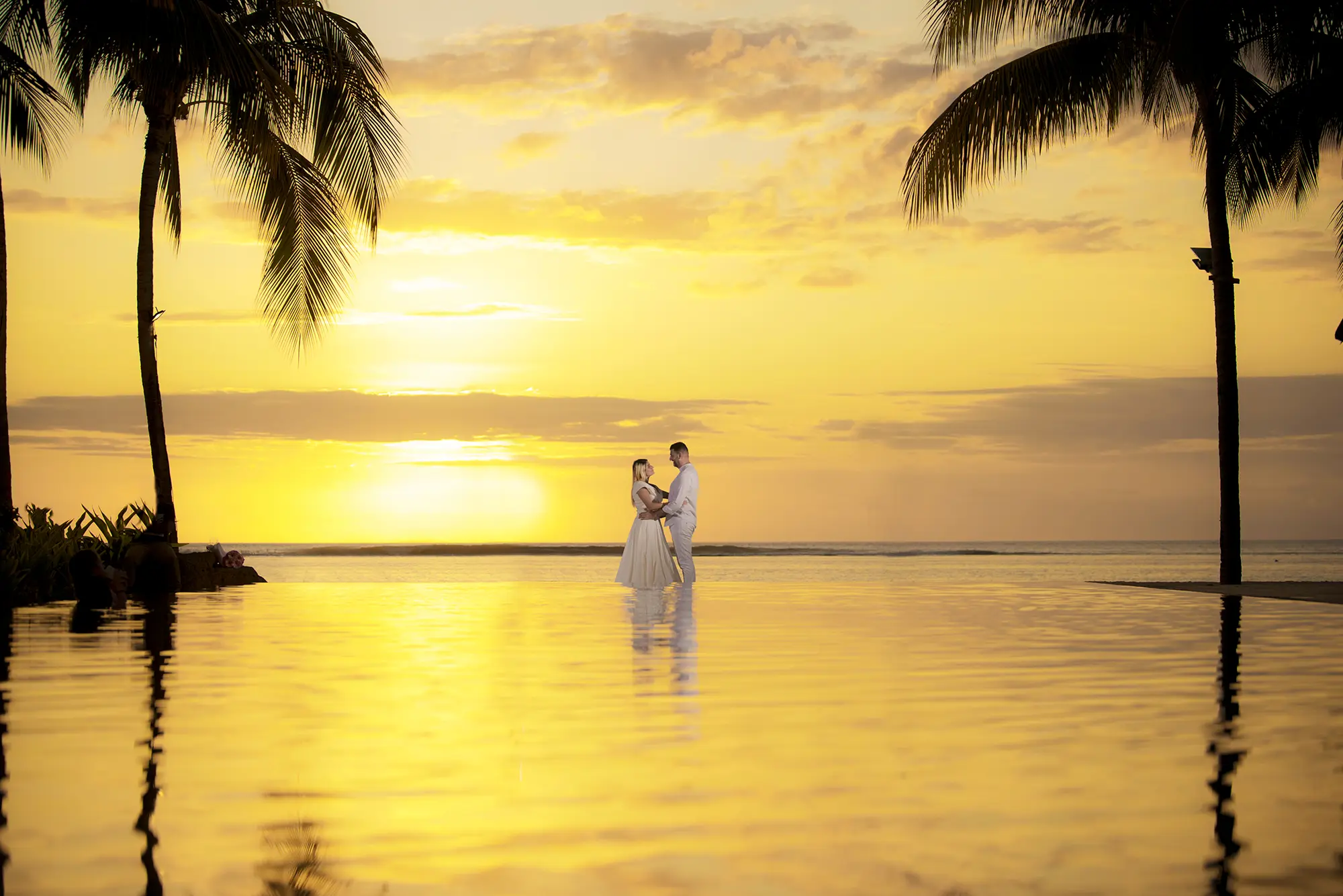
Flic en Flac faces directly west. There is no reef island, no headland, no neighbouring landmass between the beach and the horizon. The sun travels its full arc across the sky and then descends — slowly, theatrically — directly into the Indian Ocean directly ahead of you. The sequence typically runs 45–60 minutes: the light turns from white to gold around 90 minutes before sunset; by 30 minutes before, it is amber; the last 10 minutes produce a molten red horizon that reflects off the lagoon surface; and as the sun touches the water, the sky turns every shade from orange to deep crimson to violet.
That colour range, and the way it behaves on skin, fabric and water simultaneously, is why Flic en Flac produces the most dramatic couple photographs anywhere in Mauritius. A silhouette with that sky behind it is not a photograph — it is a painting. East coast hotels will sell you spectacular sunrise photography packages; if you want the sunset, there is only one answer, and it is the west coast.
The warmth of the lagoon water also plays a role. Because the west coast is more sheltered from the south-east trade winds (the primary wind direction in Mauritius), the sea surface is typically glassier at sunset than on the east, giving cleaner reflections and a more serene atmosphere. On a calm evening, the water at Flic en Flac turns into a mirror at the moment of sunset — the sky above and the reflection below become a single continuous wash of colour, with the couple or subject as the only vertical element in the frame.
The Beach in Detail
Eight kilometres is a significant stretch. Walking the full length of Flic en Flac beach takes over an hour, and the character changes considerably from one end to the other. Understanding the different sections is useful whether you are choosing a hotel, planning a photoshoot or simply deciding where to spend the afternoon.
Sand and Water Quality
The sand at Flic en Flac is white to cream — finer and paler in the protected hotel stretches, slightly coarser and more natural in the public areas. There is no significant seagrass problem here (unlike parts of the south coast), and the beach is generally clean and well-maintained. The public beach areas — particularly the central stretch around the Flic en Flac village — are managed by the municipality and swept regularly.
The lagoon water is warm, clear and shallow close to shore — typically knee to waist depth for 50–100 metres before a gentle drop-off. Visibility is good year-round, and the turquoise-to-deep-blue colour gradient from the shore outwards is exactly what you see in the photographs. This is not a digital enhancement; it is what the west coast lagoon looks like in real life in good light.
Reef Position and Swimming Conditions
The barrier reef at Flic en Flac sits further offshore than on the east coast. This has two consequences. First, a slightly larger swell can occasionally enter the lagoon during rough weather — particularly in summer (November–April) when cyclonic systems pass. On most days, conditions are perfectly calm, but it is worth checking before entering the water during the cyclone season. Second, the reef's distance means that the break at the reef edge — where the lagoon turquoise transitions to deep ocean blue — is further out and often visible from shore, which makes for a more dramatic backdrop in aerial photography.
For swimming, the calmer stretches are the hotel beach areas (Sugar Beach, Maradiva, Sofitel) where the shoreline is managed and lifeguards are present during resort hours. The central public beach is also generally safe; it is the northern and southern extremities of the 8km arc that can have stronger currents.
Public Beach vs Hotel Stretches
Unlike some parts of Mauritius where resorts have effectively privatised long stretches of shoreline, Flic en Flac has a healthy balance. The law in Mauritius mandates public access to beaches, but in practice, hotel stretches are managed and furnished — sunbeds, service, security. The central public beach has excellent facilities: parking, food stalls, benches, a children's play area. For photography purposes, the public stretch offers more freedom of movement and less interference, while the hotel stretches offer pristine maintenance and better facilities.
Photography at Flic en Flac
I have photographed more sunsets at Flic en Flac than I can count, and every session is different. The light here moves fast. Understanding the five key positions — and when to be at each — is the difference between adequate sunset photographs and genuinely exceptional ones.
Position 1 — Centre Beach, Looking North
The most versatile position. Standing at the central public beach and shooting north along the coastline gives you the beach curving away into the distance, the sunset light raking across the sand, and a completely clean horizon to the west. There is minimal clutter — no jetties, no boat traffic, no resort infrastructure in the frame. This is the position I use for wide environmental portraits: the couple as a small element in a vast, coloured landscape. Arrive 90 minutes before sunset and position yourself mid-beach. The light is already cinematic at this point and will improve for the next hour.
Position 2 — The Rocks at Pointe aux Salies
At the southern end of Flic en Flac, where the beach transitions into the rocky headland of Pointe aux Salies, the coastline changes character entirely. Large dark volcanic rocks jut into the lagoon, wave action creates foam and movement, and the silhouette possibilities are extraordinary. The jagged foreground creates a frame within a frame — the couple or subject placed between two rock formations with the sunset horizon beyond. This is the most dramatic and technically challenging position, requiring careful timing to capture the wave movement without getting subjects wet. Recommended for confident, adventurous couples.
Position 3 — La Balise Marina at Sunset
A few kilometres north of the main Flic en Flac beach, La Balise Marina offers a completely different visual vocabulary. Boats moored in the marina, their masts and hulls reflected in the still water, the sunset sky framed between the dock structures. This is a location for editorial and travel-style photography — less about romance, more about lifestyle and place. The reflections in the marina water at golden hour produce images with a quality of light that is almost impressionistic. The restaurant terrace at the marina is also excellent for post-shoot dining.
Position 4 — Aerial at Golden Hour
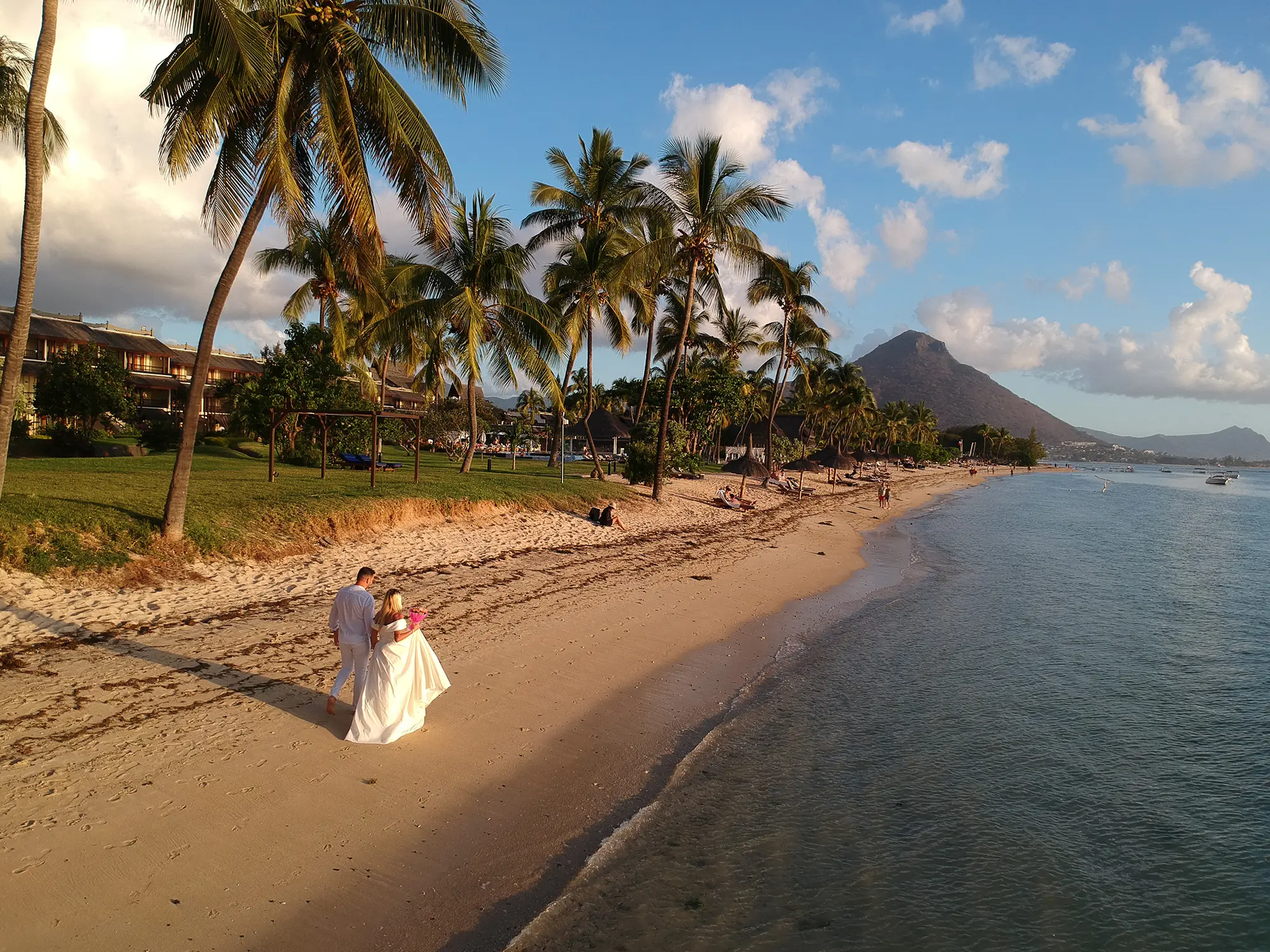
No other position demonstrates the scale and beauty of Flic en Flac like a drone at 40–80 metres. From above, the 8km arc of white sand curving northward, the turquoise lagoon transitioning to deep blue at the reef edge, and the warm golden light painting the entire scene from the west — it is one of the most arresting aerials I produce anywhere in Mauritius. I always fly at golden hour rather than midday: the raking low light creates depth and shadow that flat overhead shots cannot achieve. The couple, seen from above as two small figures on the vast beach, with their shadows stretching east behind them — this is the image that clients consistently choose as their album cover.
Position 5 — Couple Portraits Facing West
The simplest and most powerful position: the couple facing west, the sunset directly behind them. With the sun at 5–10 degrees above the horizon, the backlight produces halos — the rim of each person lit in gold, their faces in warm shadow, the sky a gradient from white at the horizon to deep amber overhead. These backlit silhouettes are the most requested images I shoot at Flic en Flac. They require no elaborate setup — just the right timing, the right angle relative to the sun, and subjects who are comfortable being directed. I position the couple's faces slightly toward a reflector or toward the open lagoon to keep detail in their features while the background burns with colour behind them.
Best arrival time: 90 minutes before sunset. Use the first 30 minutes for wider environmental shots while the light is still relatively white. The 60-to-30-minute window before sunset is the golden hour proper — warm, directional, flattering. The final 30 minutes are for the drama: the deep reds, the silhouettes, the last burst of colour before the sun disappears. Stay for 10–15 minutes after sunset for the blue hour, when the sky turns a rich indigo and the beach lights begin to glow — a completely different but equally beautiful image.
Diving and Marine Life
Above the waterline, Flic en Flac is famous for its sunsets. Below it, the west coast is equally celebrated — and among serious divers, the underwater landscape here is considered among the finest in the entire Indian Ocean. The combination of the Rempart submarine wall, the Cathedral cave system and the extensive fossil coral formations gives the site a variety and depth that few locations worldwide can match.
The Rempart Submarine Wall
The Rempart wall begins at around 12 metres depth and drops vertically to 30 metres and beyond, its face covered in sea fans, soft corals and sponges in colours that rival anything above the waterline. Visibility on a good day exceeds 25 metres, and the wall's orientation means it catches the light from above in a way that makes depth photography exceptional. Schools of jacks, barracuda and the occasional hawksbill turtle patrol the open water adjacent to the wall. For experienced divers, a night dive on the Rempart wall is genuinely memorable — the wall fauna transforms after dark, with sleeping turtles on ledges and hunting lionfish emerging from the crevices.
The Cathedral Caves
The Cathedral is Flic en Flac's most photographed dive site — an interconnected series of underwater caverns where shafts of surface light penetrate from above, illuminating the interior in shifting beams. The effect is genuinely otherworldly: divers are silhouetted against the light from above, the cave walls glow with bioluminescent organisms, and the acoustic dampening underwater creates a sense of absolute silence. Maximum depth is around 24 metres. The Cathedral requires a qualified guide who knows the entry and exit points; all the established operators on the beach run dedicated Cathedral dives.
Fossil Coral and Shallow Reef
Closer to shore, the shallow reef system at Flic en Flac is excellent for snorkelling and beginner diving. Fossil coral formations — ancient reef structures now colonised by living organisms — create a complex, layered habitat with excellent fish diversity. Octopus, moray eels, parrotfish, surgeonfish and pufferfish are common. The shallow depth (3–8 metres) and proximity to shore make this an accessible entry point for those new to diving or snorkelling.
Dive Operators
Three well-established operators run from the Flic en Flac beachfront: Blue Safari (the largest and most experienced, offering PADI certification courses, guided dives and underwater scooter experiences), Atlantis Diving Centre (known for their Cathedral expertise and small group sizes), and Sub Diving (independent, highly regarded for personalised service and night dives). All three can be booked directly from the beach or through the main resort hotels. Equipment hire is included in the dive fee.
Hotels at Flic en Flac
Three five-star properties sit directly on the Flic en Flac beach, each with a distinct character and a different photography proposition. Choosing between them depends on the nature of your stay — whether you are celebrating a honeymoon, planning a beach wedding, or simply want the finest possible base from which to experience the west coast.
Sugar Beach
Sugar Beach occupies one of the longest private beach stretches at Flic en Flac — a broad arc of white sand with consistent depth and excellent conditions for both swimming and photography. The resort's colonial plantation architecture (white colonnades, wooden shutters, manicured gardens) creates a formally beautiful backdrop for portraits, particularly in the late afternoon when the long shadows from the arched walkways create extraordinary patterns on the whitewashed walls. The beach here is maintained to an exceptional standard. For honeymoon couples seeking a combination of luxury, privacy and photographic variety — the beach at golden hour, the architecture in the garden, the pool at sunrise — Sugar Beach delivers consistently. See the Sugar Beach photography gallery.
Maradiva Villas Resort & Spa
Maradiva is the most private property at Flic en Flac — an all-villa resort with no hotel-style rooms, no corridors, no lobby crowds. Each villa has its own pool and direct or near-direct beach access. The privacy here is absolute, and for photography, that privacy is invaluable: when I shoot a honeymoon couple at Maradiva, there are no passing guests to navigate around, no background clutter of strangers. The villa interiors are designed with restraint — natural materials, neutral palettes, Indian Ocean views from the bed — and produce beautiful interior lifestyle shots in the morning light. The sunset from Maradiva's beach is the full Flic en Flac experience, framed between the villa garden palms. See the Maradiva photography gallery.
Sofitel Imperial
The Sofitel Imperial is the grandest of the three properties in scale — a large resort with multiple restaurants, a sprawling pool complex and a beach stretch that captures the full drama of the Flic en Flac sunset. The Imperial's beach faces precisely west, and on a clear evening, shooting from the resort's shoreline toward the horizon produces some of the most dramatic available-light photographs I take anywhere in Mauritius. The resort's size also means more photographic variety: the formal gardens, the pool, the restaurant terraces, the beach — all within a few hundred metres of each other. For couples who want a wide range of backdrops within a single property, the Sofitel Imperial is the best-endowed option at Flic en Flac. See the Sofitel Imperial photography gallery.
The Village and Eating
What distinguishes Flic en Flac from a purely resort-driven beach like some parts of the east coast is the persistence of its actual village. The settlement of Flic en Flac predates the tourist industry by generations, and despite the luxury hotels on its doorstep, it has maintained a genuine local identity. The shops, bakeries, market stalls and family-run restaurants that line the main street behind the beach are not staged for tourists — they are simply there, functioning, as they have been for decades.
This matters photographically and culturally. A couple staying at Maradiva who walks five minutes from the hotel gate enters a completely different world: the smell of fresh bread from the boulangerie at 07:00, the fish market opening at 06:00 with the overnight catch, the old men playing cards under the casuarina trees in the afternoon. This is the real Mauritius alongside the five-star version — and clients who experience both come away with a more complete understanding of the island.
Where to Eat
Nautilus is the west coast's most respected seafood restaurant — a beachfront institution with a view that matches the food. The grilled red snapper, the seafood platter and the lobster thermidor are the benchmarks by which I judge every other seafood meal in Mauritius. Book in advance for a sunset table; they fill up quickly. La Bonne Chute is the local favourite for Mauritian Creole cooking — rougaille, biryani, vindaye — in a simple, unpretentious setting that feels entirely authentic. The rougaille poisson here is one of the best versions of the dish anywhere on the island. For a lighter lunch, the seafood shacks along the public beach serve freshly grilled fish and octopus salad that would cost three times the price in a resort restaurant a hundred metres away.
The bakeries (boulangeries) in the village open early and are worth the walk: Mauritian bread — the baguette-like pain maison — is made fresh each morning and has a crust and flavour that the hotel breakfast rooms cannot replicate. Pick up a loaf and some local palm-heart chutney for a breakfast on the beach that no five-star buffet can match.
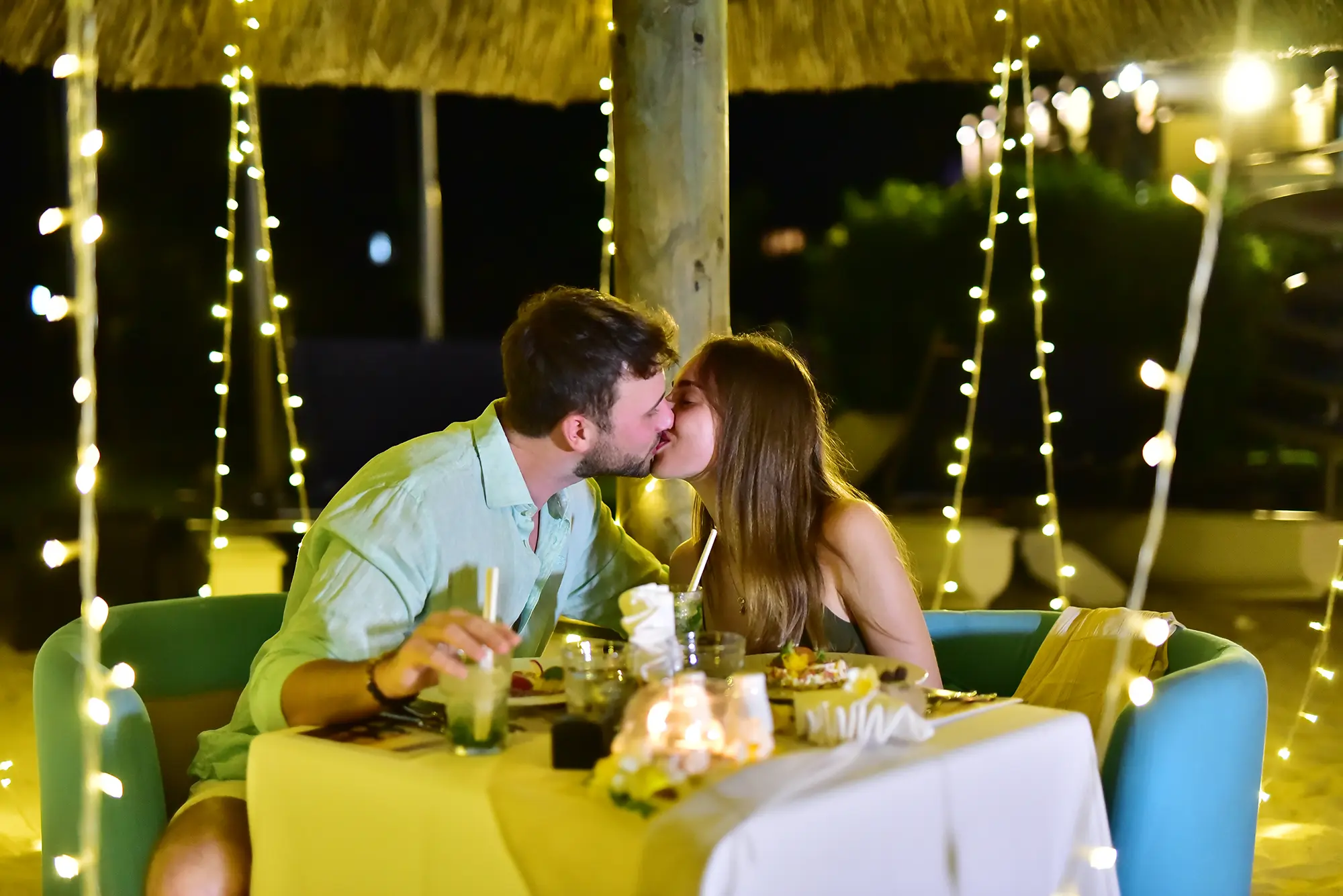
In the evenings, the beach bar culture around the central public beach is relaxed and genuinely local — rum sours, Phoenix beer, the occasional live sega music. This is not a performance for visitors; it is simply what happens here on a warm evening. I have ended more photoshoots than I can count at one of these bars, watching the last colour fade from the sky and talking through the day's images with clients. It is one of the best ways to end a session in Mauritius.
Getting to Flic en Flac
Flic en Flac sits on the west coast of Mauritius, approximately 20km south-west of Port Louis. Its location makes it well-connected by road from most parts of the island, though the routes differ in speed and character.
From Port Louis (40 minutes)
The fastest route from Port Louis takes the M2 motorway south toward Curepipe, then exits west at Ebène or Quatre Bornes and continues on the B13 toward Flic en Flac. In light traffic this is a 35–40 minute drive. During rush hour (07:30–09:00 and 16:30–18:30 on weekdays), allow up to 60 minutes. The coastal road approach via Rivière Noire is more scenic but slower.
From Grand Baie (1 hour)
Grand Baie is on the north coast, and the drive to Flic en Flac runs south through Port Louis and then west, or alternatively via the motorway junction at Terre Rouge. Total driving time is 50–65 minutes depending on the route and traffic through Port Louis. The motorway bypass of the city centre cuts around 15 minutes off the traditional coast road. Taxis from Grand Baie to Flic en Flac cost approximately 800–1,000 MUR (roughly €18–22).
From Sir Seewoosagur Ramgoolam Airport (1 hour)
The airport is in the south-east of the island, and the drive to Flic en Flac follows the motorway north through Mahébourg and Curepipe before heading west. Allow 60–75 minutes in normal traffic, up to 90 minutes in peak hours. Pre-booked airport transfers to the Flic en Flac hotels cost approximately €35–50 per transfer depending on the provider. Most hotels offer dedicated airport pick-up; contact your hotel or ask me for a trusted transfer contact.
Parking
Flic en Flac has a large free public car park adjacent to the central beach. It fills up on Sunday afternoons and public holidays (when the beach is very popular with local families), but is generally manageable during the week and in the mornings. Hotel guests park within their resort grounds. For photoshoots, I recommend arriving early to secure the best position — both for parking and for the light.
Driving Conditions
Mauritius drives on the left. Road quality on the main routes to Flic en Flac is good, though some secondary roads in the village itself have potholes. A standard car is sufficient; four-wheel drive is not required. Speed limits are 50km/h in built-up areas and 80km/h on the main roads. The police enforce speed limits rigorously on the main arterials, particularly on the motorway. GPS navigation apps (Google Maps and Waze both work well in Mauritius) are reliable for finding the hotels and the public beach car park.
Flic en Flac — Frequently Asked Questions
Capture Your Mauritius Memories
Drone aerials. Golden-hour portraits. The turquoise lagoon as your backdrop. 15 years shooting Mauritius's most beautiful beaches.