The Complete Mauritius Honeymoon Guide
Last updated: June 2026 · By Bilaal Sadeer
I have been photographing honeymoon couples in Mauritius for fifteen years. In that time I have shot on every beach, inside every five-star resort, and at every time of year. This guide is everything I know — the best months, the best hotels for photography, what to actually do, and how to choose a shoot package that gives you images worth keeping forever. No affiliate links. No filler. Just the honest picture.
Mauritius Honeymoon — Key Facts
- Flights: 4–11 hours from London, Paris, Dubai and Mumbai — direct routes available from all four.
- Average couple budget for 7–10 nights: €3,000–€15,000 depending on hotel tier.
- Best months to visit: May to November (dry season, calm seas, consistent golden-hour light).
- Visa-free entry for citizens of 90+ nationalities — no advance application required.
- Honeymoon photography: €160 per hour — drone, unlimited photos, 3-day delivery, island transfers all included.
- Most popular shoot format: 2-hour sunset session (€320) — gallery delivered before you fly home.
Why Mauritius for a Honeymoon
Every week I photograph couples who have looked at the Maldives, Bali, Seychelles and Mauritius, and chosen Mauritius. After fifteen years, I understand why — and I also know the honest answer, which is more nuanced than the brochures suggest.
Mauritius wins on variety. The Maldives is extraordinary but it is, in essence, one experience: a water villa over a flat lagoon. Mauritius has a dramatic south-west coast dominated by the UNESCO-listed Le Morne Brabant cliff — the most photographed spot in the Indian Ocean — and a mirror-calm east coast with the finest white-sand beaches in the region. It has a mountainous interior, waterfalls, Black River Gorges National Park, colonial tea estates, Chamarel's Seven Coloured Earth, and a capital city, Port Louis, that is genuinely worth a half-day. You can have a beach honeymoon and still feel like you have seen a country.
It wins on infrastructure. Mauritius has some of the most accomplished five-star hospitality in the world — the Constance group, One and Only, Shangri-La and the local Beachcomber and Heritage groups all operate at a level that rivals anything in the Maldives or Seychelles, but with significantly better food, more diverse activities, and easier access. Direct flights from London take nine hours. From Paris, ten. From Dubai, four. From Mumbai, five. You arrive rested and ready.
And it wins on photography. The light in Mauritius — particularly on the south-west coast at Le Morne — is something I have never found anywhere else. The combination of the reef, the turquoise shallows, the submerged waterfall optical illusion, and the cliff creates an hour of light before sunset that is, in fifteen years of shooting, the most consistently magical I have ever worked in. Couples who plan their photoshoot for that window leave with images that look like they were made by a Hollywood unit with a crew of twenty. It is just the place.
The honest qualification: Mauritius has a cyclone season (December to March) that can affect holidays, and the south-east trade winds make some beaches choppy from June to August. Both are manageable with good planning — which is what this guide is for.
When to Go — Month-by-Month Guide
Mauritius has two distinct seasons. Understanding them properly — not just the headline "dry season / wet season" — makes a real difference to your honeymoon and to how your photographs look.
May–June — The Opening of the Best Season
The south-east trade winds arrive in May and bring cooler, drier air. Sea temperatures are still warm (26°C). Crowds have thinned since the Easter school-holiday peak. June is, for my money, the single best month to visit: reliably dry, good sea state, extraordinary golden-hour quality, and hotels are not yet at peak occupancy. Photography in June produces the crispest blues and the warmest amber tones I see all year. If you have flexibility, choose May or June.
July–August — Peak Season
The most popular months, and for good reason: weather is near-perfect, the sea on the west coast (Le Morne, Flic en Flac) can be slightly choppy from the trade winds, but the east coast (Belle Mare, Le Touessrok) remains completely calm. Prices are at their highest. Hotels book out months in advance. If you are travelling in July or August, book everything — hotel, photography, activities — at least six months ahead. The light is excellent but similar to June.
September–November — The Hidden Best Months
September and October are my personal recommendation for honeymoon couples who want the best combination of weather, light and value. The trade winds ease off, the sea becomes glassy on both coasts, temperatures are warm without being hot, and prices drop by 15–25% from peak. November is warm and increasingly humid as the wet season approaches, but still largely dry. Photography in October particularly — when the light goes golden against a greener landscape — is spectacular.
December–April — Wet Season
Hot, humid, and subject to heavy rain — sometimes prolonged. Cyclone risk is real from January to March (though cyclones rarely make direct landfall on the island). That said, December and April are shoulder months — the weather is not reliably good, but it is not uniformly bad either. The light after a tropical rain shower is extraordinary. If budget is a primary consideration and you are willing to accept weather uncertainty, December and April can deliver a perfectly good honeymoon. January to March: only if you have no other option.
| Month | Weather | Sea | Photo Light | Crowds |
|---|---|---|---|---|
| May | Dry, 26°C | Calm | Excellent | Low–medium |
| Jun | Dry, 24°C | Calm | Best of year | Low |
| Jul–Aug | Dry, 23–24°C | Choppy west, calm east | Excellent | High |
| Sep–Oct | Dry, 25–27°C | Very calm | Outstanding | Low |
| Nov | Warming, some rain | Calm | Good | Medium |
| Dec–Apr | Hot, wet, cyclone risk | Variable | Variable | Medium–high (Dec) |
Where to Stay — The Best Honeymoon Hotels in Mauritius
I have photographed at virtually every five-star resort in Mauritius. What follows is based on direct experience — not marketing materials. For each property I have noted what it is best for, the beach quality, and its photography potential for honeymoon couples.
Paradis Beachcomber, Le Morne
The most dramatic setting in Mauritius. The Le Morne Brabant cliff — a UNESCO World Heritage site — rises directly behind the resort, and the beach at Paradis is directly on the south-west lagoon with the submerged waterfall optical illusion just offshore. Best for: couples who want extraordinary landscape backdrops, water sports, and the most dramatic photography in the Indian Ocean. Beach quality is exceptional but the west-coast trade winds make July–August swimmable rather than perfectly calm. See the Paradis Beachcomber gallery.
Constance Belle Mare Plage, East Coast
The finest beach in Mauritius is at Belle Mare — 800 metres of powder-white sand and mirror-calm turquoise water. Constance Belle Mare Plage is the east coast's most refined resort, with two 18-hole golf courses, multiple restaurants, and a spa that regularly features in global rankings. Best for: couples who prioritise beach quality above everything else. The east-coast calm makes swimming perfect year-round. Sunrise photography here is among the best I have produced anywhere. See the Constance Belle Mare gallery.
Shangri-La Le Touessrok, East Coast
Le Touessrok occupies a peninsula on the east coast with access to a private island — Île aux Cerfs — that is one of the most beautiful spots in Mauritius. The resort has multiple beaches, a championship golf course on the island, and a Iridium Spa. Best for: couples who want variety and activity alongside luxury — boat transfers to the private island, kayaking, windsurfing, and some of the best dining on the island. Photography at the private island, from the water or with drone, is exceptional. See the Shangri-La Le Touessrok gallery.
One and Only Le Saint Géran, East Coast
The most exclusive address in Mauritius — a near-private peninsula with one of the world's finest hotel spas and a level of service that justifies the price. Best for: couples for whom complete privacy and absolute luxury are the non-negotiable priorities. The beach is excellent, the photography potential outstanding, and the resort's scale means you rarely see other guests. Weddings and honeymoons here tend to be smaller, more intimate affairs. See the One and Only Le Saint Géran gallery.
Heritage Le Telfair, Bel Ombre
A colonial estate resort in the south, surrounded by former sugar-cane fields and a nature reserve. Le Telfair has a distinct character — more serene and land-focused than the beach resorts — with nature walks, a golf course designed into the landscape, and some of the best food on the island. Best for: couples who want something quieter and more distinctive, who enjoy nature and walking, and who want a resort that feels genuinely Mauritian rather than a generic tropical luxury package. The estate grounds and forest backdrops offer photography unlike anywhere else on the island. See the Heritage Le Telfair gallery.
LUX Le Morne
A stylish, art-forward resort at Le Morne with direct beach access and one of the strongest value propositions at the luxury tier. LUX properties across Mauritius are known for their design sensibility — interesting art, well-considered interiors, strong F&B — and Le Morne in particular benefits from its extraordinary location. Best for: couples who want the Le Morne backdrop without the Paradis price tag, and who appreciate design and cultural programming alongside beach time. Photography potential here is identical to Paradis in terms of landscape — you are on the same beach. See the LUX Le Morne gallery.
What to Do on Your Mauritius Honeymoon
A honeymoon in Mauritius does not have to be entirely horizontal. Here are the activities that genuinely make the experience — and a few that photograph exceptionally well.
Sunset Catamaran Cruise
The classic Mauritius honeymoon experience, and deservedly so. A private or small-group catamaran from the west or north coast, sailing along the reef at golden hour, with champagne and Creole food. The light on the water during the last 45 minutes before sunset — viewed from the sea, with the island behind you — is extraordinary. I offer combined catamaran and photography sessions if you want this documented properly.
Dolphin Swimming, Tamarin Bay
Spinner and bottlenose dolphins shelter in the warm waters of Tamarin Bay on the west coast. Early morning boat trips from Tamarin (before 8am) regularly encounter them in open water — swimming alongside wild dolphins in the Indian Ocean is genuinely moving. This is not a commercial enclosure; it is wild ocean, and they choose to approach. Book through a local operator rather than a resort for a more genuine experience.
Île aux Cerfs, East Coast
A private island off the east coast accessible by boat from Le Touessrok or independent operators from Mahébourg. White sand, clear shallow water, snorkelling, water sports, and beach bars. At its best in the morning before the day-trip crowds arrive. The photographic potential here — the sandbanks, the shallow turquoise water — is very high. If you stay at Shangri-La Le Touessrok you have private access; otherwise go early on an independent boat.
Blue Bay Marine Park, South Coast
The most accessible and genuinely impressive coral reef in Mauritius. Blue Bay is a marine park on the south-east coast with healthy coral, parrotfish, sea turtles and rays visible in clear shallow water. Snorkelling here is excellent without needing to dive. Combine it with a visit to Mahébourg market and the colonial town for a full south-coast day.
Seven Coloured Earth, Chamarel
A geological formation in the south-west where volcanic ash has created seven distinct soil colours — burnt orange, violet, red, blue and more — in a natural amphitheatre. Nearby: the Chamarel waterfall, rum distillery, and the most scenic drive on the island through Black River Gorges. Best visited in the morning when the colours are saturated and the light is overhead. A full day in the south-west combining Chamarel, the gorges and a Le Morne sunset photoshoot is one of the best days you can have in Mauritius.
Spa Day and Private Beach Dinner
Every five-star resort in Mauritius has a world-class spa. Block a morning for treatments — the Four-Hands massage available at several properties is remarkable — then arrange a private beach dinner through your resort for the evening. A table set directly on the sand, at the water's edge, at dusk: this is what Mauritius does better than anywhere else in the world. Ask your hotel to set it up for the third or fourth night, once you have settled in.
The Honeymoon Photoshoot — What to Expect
The two-hour sunset session is the most popular format I offer, and for good reason: it fits naturally into a honeymoon schedule, it catches the best light of the day, and 120 minutes is enough time to cover three or four distinct locations without feeling rushed. Here is exactly how it works.
Timing and Duration
We start 90 minutes before sunset. The first 30–40 minutes are the warmest, most directional light of the day — ideal for beach portraits, water shots, and the close-up work. The final hour, from roughly 30 minutes before sunset to 30 minutes after, is what photographers call the golden hour and blue hour: a sequence of light that moves from warm amber to deep gold to soft blue. In this window I use both natural light and — where the situation permits — drone. By the time we finish, the sky is typically a deep indigo and the lagoon has gone still.
Drone Coverage
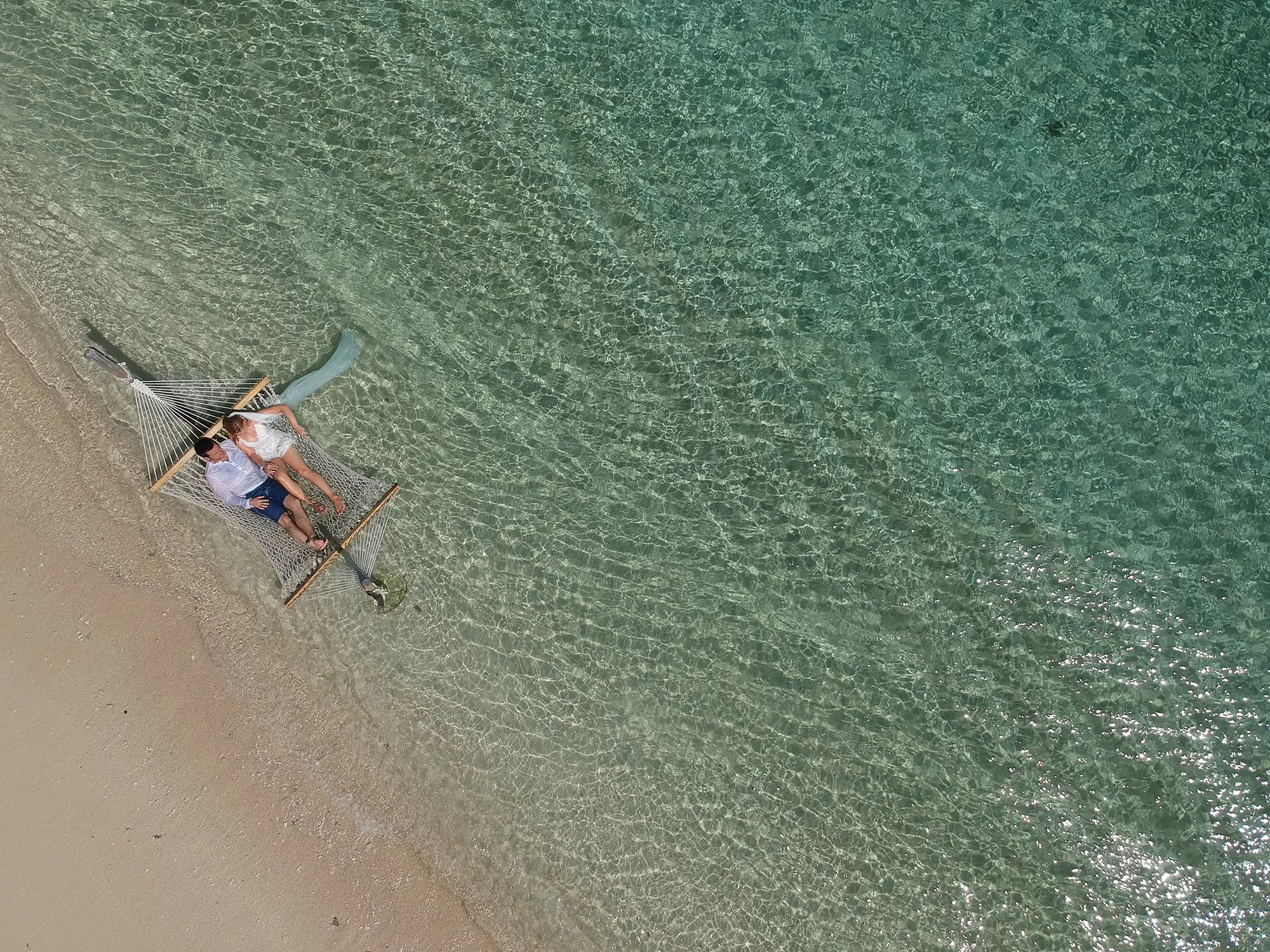
Drone is included in every session where regulations permit. Most beach locations in Mauritius outside of airport exclusion zones are flyable. The aerial perspective — the two of you on a strip of white sand with the turquoise lagoon and the reef visible from above — is the image couples most frequently use as their framing print. I fly the DJI Air 3 and always carry a spare battery. The drone goes up during the final 20 minutes of light.
Locations
I recommend the location based on where you are staying and what you want in your images. Couples at Le Morne naturally shoot at Le Morne — the cliff and lagoon combination is unmatchable. Couples on the east coast shoot at Belle Mare or the Île aux Cerfs sandbanks. I know every worthwhile spot on the island and will guide you to the best option for your dates, your hotel, and the light on that specific day.
What to Wear
Light colours photograph well against the turquoise and sand — white, ivory, pale blue, soft coral. Avoid black in full sun (it absorbs heat and can look flat against a bright background). Bring one outfit for the beach and consider a second change for the end of the session when the light goes blue. Flowing fabric — a maxi dress, a loose linen shirt — moves beautifully in the trade wind. Pack a small bag: lipstick, hairpins, a compact mirror. Bare feet are almost always the right choice on sand.
Delivery and Gallery
Every session is delivered within 3 working days via a private Google Drive gallery. If you are on a 7-night honeymoon and book the session on day 2 or 3, you will have your gallery before you fly home. All images are colour-graded and retouched. Unlimited photos means I deliver everything worth keeping — typically 80–150 images from a two-hour session, not a curated selection of twenty. You receive full-resolution files for printing.
How to Book
Send a WhatsApp to +230 5732 7738 with your dates and hotel. I will confirm availability and we agree the location and start time based on that day's sunset. A €80 deposit via PayPal holds your date; it is fully refundable if I am unavailable. The balance is settled in cash or via transfer at the end of the session.
Mauritius Honeymoon Budget Guide
Here is an honest breakdown of what a Mauritius honeymoon costs at three different levels. All figures are for two people, 7–10 nights, including flights from Europe.
| Tier | Total Budget | Hotel | Activities | Photography |
|---|---|---|---|---|
| Budget | €3,000–€5,000 | 3-star guesthouse or B&B (€60–€120/night) | Self-guided, public beaches, local tours | 1-hour session €160 |
| Mid-Range | €5,000–€8,000 | 4-star all-inclusive (€200–€350/night) | Catamaran cruise, Chamarel day trip, dolphin swim | 2-hour sunset session €320 (drone included) |
| Luxury | €12,000+ | 5-star resort or private villa (€500–€1,200+/night) | Private catamaran, spa packages, private beach dinner, island transfers | 3-hour session €420 (drone, 3-day delivery, full retouching) |
Flights from London/Paris: approximately €600–€1,200 per person return depending on season. All photography packages include drone, unlimited photos, cinematic retouching, 3-day delivery and island-wide transfers. No hidden fees.
Mauritius Honeymoon — FAQ
Capture Your Mauritius Memories
The Indian Ocean. The two of you. 3-day delivery so you have your gallery before you fly home.
Ready to confirm your date?
Pay €80 Deposit to Hold Your DateDeposit deducted from total. Fully refundable if Bilaal is unavailable.