The Perfect Proposal — Le Morne at Golden Hour, Photographed in Secret
Published: June 2026 · By Bilaal Sadeer
Antoine sent me a WhatsApp message three weeks before he proposed to Sofia at Le Morne. He asked one question: could I be there, in position, without her ever knowing? This is the story of what happened — the planning, the hiding spot, the wind, the light, and the moment that made all of it worth it.
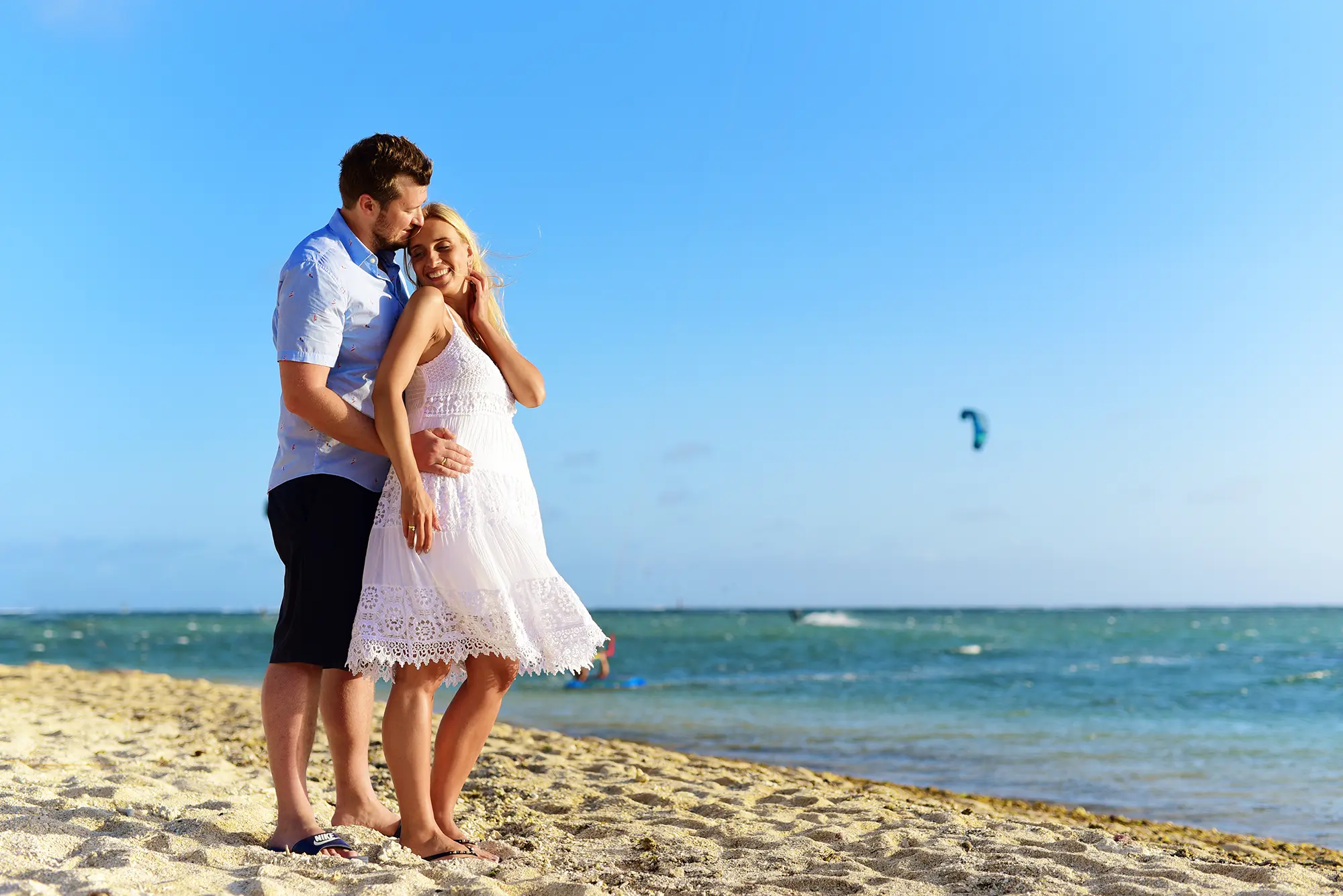
This Proposal Shoot — Key Facts
- Location: Le Morne western beach, south-west Mauritius.
- Timing: 40 minutes before sunset, golden hour.
- Equipment: 70–200mm telephoto from 15 metres concealment in casuarina trees.
- Planning lead time: 3 weeks — including one location scout the day before.
- Signal used: Antoine touching his hair just before he knelt.
- Delivery: Full gallery sent within 48 hours. Antoine's message: "She cried twice more when she saw the photos."
The WhatsApp Message from Antoine
It was a Tuesday evening when Antoine's message came in. He had found me through a Google search — I think the phrase he used was something like "proposal photographer Mauritius secret." His message was short and to the point. He was going to propose to his girlfriend Sofia at Le Morne at sunset. He had the ring. He had the date. He had already booked the hotel. What he did not have was a photographer — and he wanted one who could be there without Sofia ever knowing.
He had three weeks.
I have done this before — secret proposal photography is actually one of the most technically demanding and logistically precise things I do as a photographer. It requires a completely different approach from a standard couple shoot. You are not directing anyone. You are not making small adjustments to the light or asking people to turn slightly. You are hiding in the landscape, watching through a long lens, and waiting for a moment that will last less than ninety seconds and will never happen again. There is no second chance. There is no asking anyone to do it again.
I told Antoine yes. Then I asked him three questions: where exactly at Le Morne, what time of day, and what signal would he use to tell me he was about to kneel?
He said he was thinking the western beach — the one that faces directly into the setting sun. He was thinking late afternoon. And for the signal, after a moment's thought, he said he would touch his hair.
Good enough. We had a plan.
The Planning — Scouting Le Morne the Day Before
I drove to Le Morne the afternoon before the proposal to scout the exact location. This is non-negotiable for secret shoots. I need to know where the sun will be at the exact time they arrive, where the shadows fall from the cliff, where the sand is wet and reflective versus dry and white, and — critically — where I can conceal myself without being visible from the beach.
Le Morne western beach is extraordinary. The cliff — the UNESCO World Heritage Le Morne Brabant — rises directly behind the shoreline to the south-east, a 550-metre mass of basalt that catches the late afternoon sun and turns a deep amber colour from about an hour before sunset. The lagoon to the west is shallow and warm, and at low tide it reflects the sky in a way that makes every photograph feel like it was made in a mirror. There is no other beach in Mauritius with this combination of cliff behind and open ocean horizon in front. For a proposal, it is essentially perfect.
The concealment challenge is the trees. The western beach at Le Morne has a line of casuarina trees set back from the shore — the kind of tall, feathery pines that grow everywhere on the Mauritian coast. They are not dense enough to hide a person completely, but with the right positioning — staying back from the tree line, keeping movement minimal, using the darker shadows between trunks — a photographer with a long lens can work from there without being noticed, especially when the couple are focused on each other and on the view.
I identified the spot: fifteen metres from the water's edge, in the shadow of three casuarinas growing close together, with a clear sightline to the section of beach where Antoine said he intended to stop. I marked the position on my phone. I checked the angle of the sun at sunset for that date — the light would come in low from the right, from the north-west, which meant Antoine and Sofia would be lit from the front if they faced the ocean, with the cliff lit in amber behind them.
The lens decision was straightforward: 70–200mm f/2.8. Long enough to work from concealment, fast enough to freeze motion in the softening light of golden hour, and with enough compression to bring the cliff visually close to the couple — so that in the frames it fills the background, dramatic and enormous, even though in reality it sits some distance behind them.
I called Antoine that evening to confirm the plan. His voice sounded like a man who had not slept in three days.
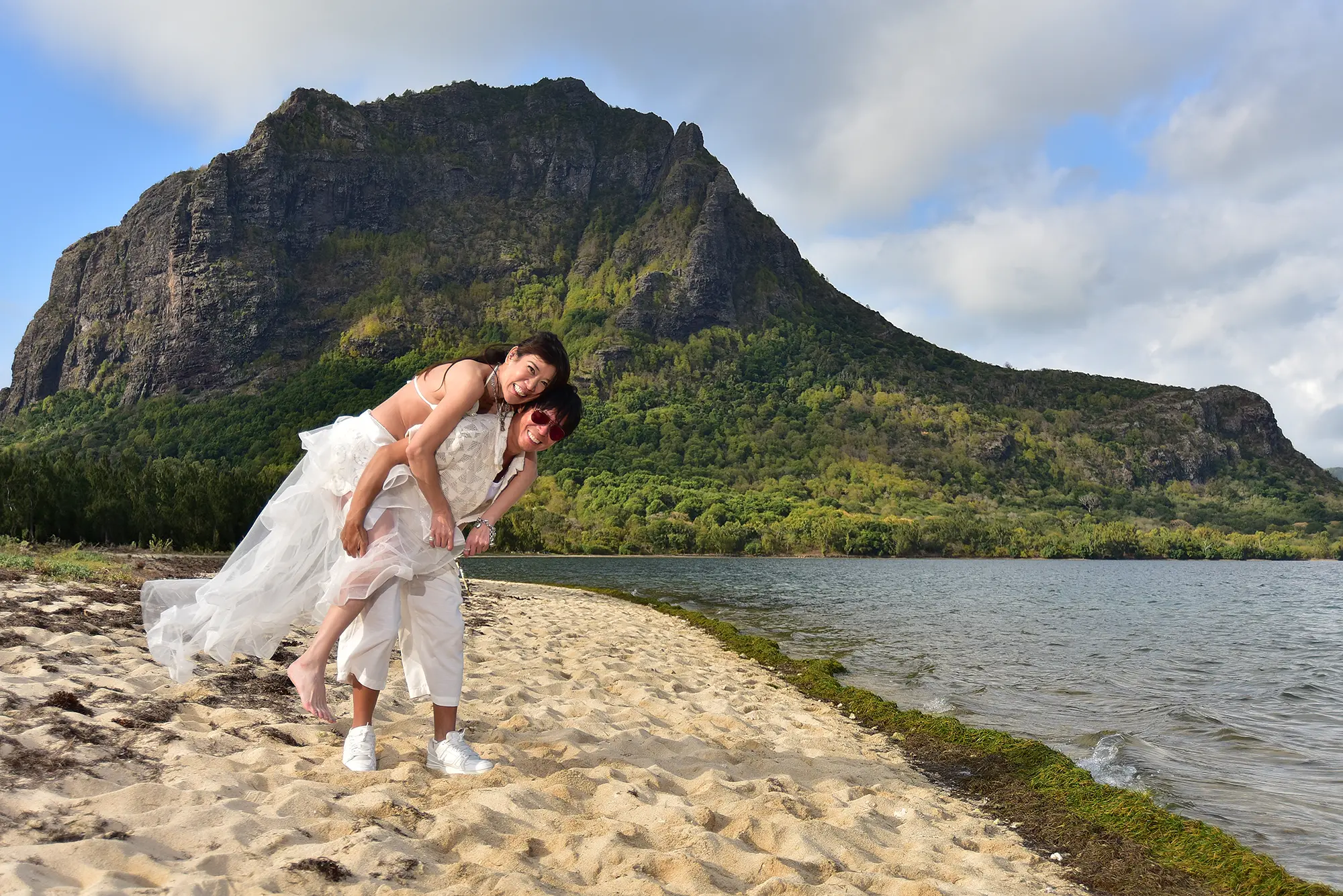
Day of the Proposal — Wind, Light and Waiting
I arrived at Le Morne two hours before Antoine and Sofia were due. Anyone watching would have seen a man with a camera bag walking along the beach — nothing unusual; photographers come to Le Morne every afternoon. I found my position in the casuarinas, tested the sightlines, and settled in to wait.
The south-east trade winds were picking up. Le Morne catches them badly — the cliff acts as a funnel and the beach can go from calm to genuinely gusty in twenty minutes. By the time I was in position, the palm trees along the shoreline were moving significantly and the surface of the lagoon had broken into small waves. The light, too, was looking ominous: a band of cloud had settled on the western horizon, low and grey, exactly where the sun was heading.
I have been in this situation before. There is nothing you can do except wait. You cannot control Mauritius weather. You cannot move the cloud. What you can do is trust the island — which in my experience tends to clear dramatically in the last forty minutes before a sunset, as if performing for an audience it knows is watching.
That is exactly what happened. Forty minutes before sunset, a gap opened in the cloud bank. The light did not just reappear — it intensified, pouring through the gap in a concentrated shaft of amber that swept across the beach and lit the cliff face like a theatre spotlight. Within ten minutes, the cloud had broken apart entirely. The trades dropped. The lagoon smoothed. The entire western horizon turned orange-pink, and the Le Morne cliff went from grey-dark to a deep, warm amber that I have only ever seen at this location at this specific time of day.
I checked my exposure. I confirmed my position. I waited.
The Moment
Antoine and Sofia arrived twenty minutes before sunset. She had no idea.
This is one of the things I watch very carefully during a secret proposal shoot — the body language differential. The person being proposed to is completely relaxed. Sofia was laughing at something Antoine had said as they walked down to the beach. She was pointing at the cliff, at the colour of the light. She was present and happy and entirely in the moment, in the way that people are when they have no reason to be self-conscious.
Antoine was a different story. His posture was slightly too upright. He kept checking the angle of the sun. Twice he put his hand in his jacket pocket and then took it out again. If Sofia had been looking at him carefully — really looking — she might have noticed. But she was looking at the ocean. People in love look at beautiful things, and at Le Morne at golden hour, there is a great deal to look at.
They walked to within ten metres of my pre-identified position. Perfect. I raised the camera.
I watched Antoine through the viewfinder. He turned to say something to Sofia. She laughed again. He turned to look at the ocean with her. A long pause. The light was extraordinary — the cliff directly behind them, burning amber and ochre, the sun a disc of concentrated orange dropping towards the horizon to the right of frame. The lagoon in front of them was still and gold.
And then Antoine touched his hair.
I was already shooting continuous at that point — but when I saw the signal, I pushed the shutter rate up and moved two steps to the left to improve the angle. Antoine reached into his jacket pocket. Sofia was still facing the ocean, her profile to me, her hair moving slightly in the fading trade wind.
He said her name. She turned.
Her hands went to her face before he had even opened the ring box. Both hands, palms flat, covering her mouth and nose, in that universal gesture of shock and emotion that is impossible to fake and impossible to miss. Her eyes were enormous. Antoine went to one knee.
The light was perfect. The cliff was lit in amber directly behind them. The lagoon caught the last of the sun. I was shooting at 1/800th of a second at f/2.8, ISO 640, and every frame was sharp.
She said yes before he had finished the sentence.
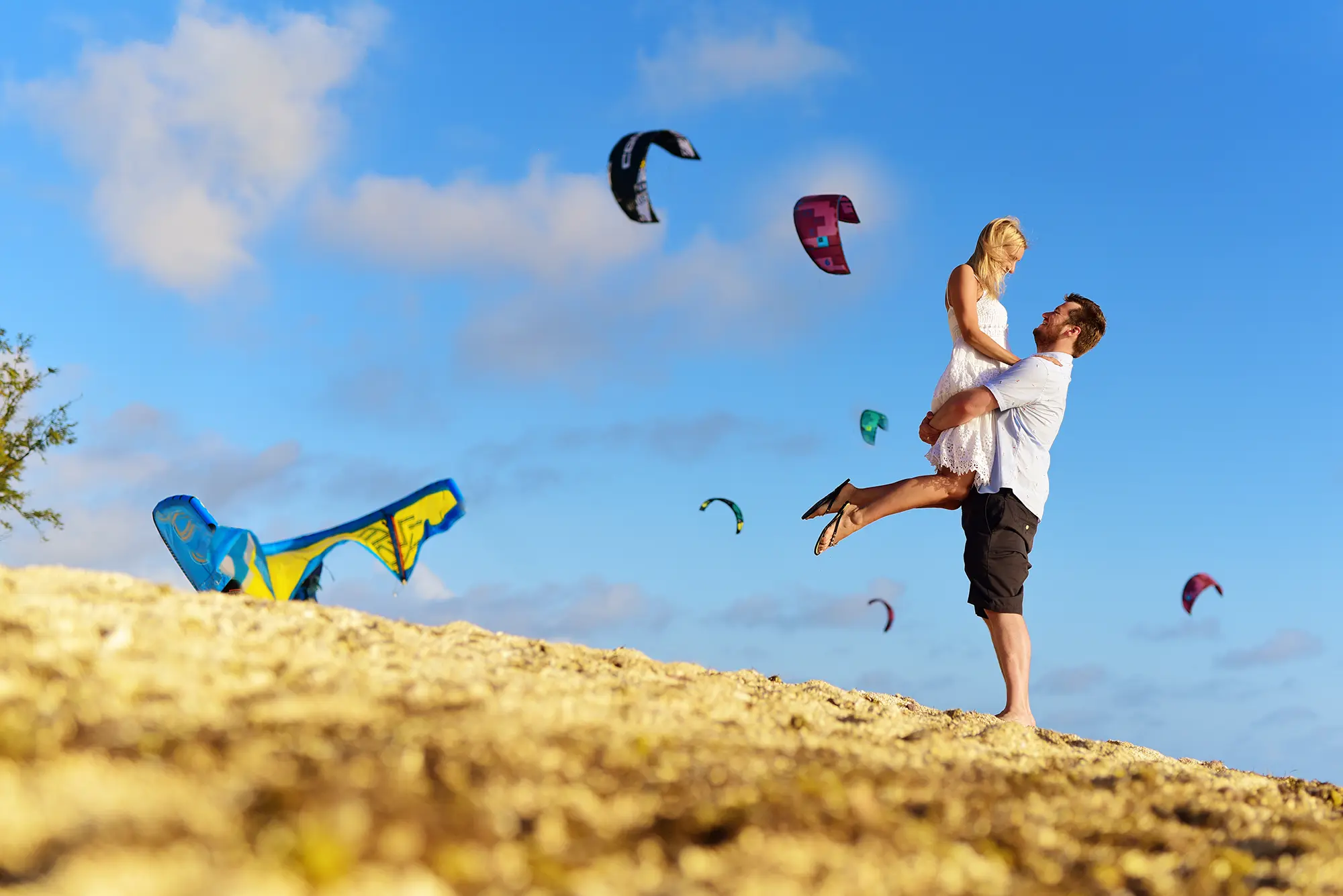
What I Captured
The sequence ran for approximately four minutes from the moment Antoine touched his hair to the moment I stepped out from the trees and introduced myself. In those four minutes, I made about 340 frames. Here is what the gallery contained.
The approach: Antoine and Sofia walking towards the water, her relaxed and animated, him slightly tense but hiding it well. The cliff lit behind them. These frames have a quality of unknowing that you cannot recreate after the proposal — they are the last photographs of Sofia as someone who did not know what was about to happen.
The turn: The moment Antoine said her name and she turned from the ocean to face him. Her expression shifting in the first half-second from casual to something she could not yet name. This is actually the rarest frame in a proposal sequence — most photographers miss it because they are waiting for the ring box. I was already on the turn because I had seen the signal.
The ring box appearing: Antoine's hands, the blue velvet box, the first moment Sofia understood what was happening. Her hands rising to her face.
Her hands to her face: This frame — both palms covering her mouth, her eyes wide, Antoine on one knee with the ring extended — is the photograph of the sequence. It is the image that says everything without needing a caption. The cliff, the light, the lagoon, the gesture. I made eleven frames in this moment. Two of them are exceptional. One of them is the kind of image that ends up framed on a wall for decades.
The yes: Sofia taking the ring. Antoine rising. The embrace — tight, slightly desperate, the embrace of two people who had just survived a moment of enormous emotional intensity together.
The moment they looked at the sky: After the hug, Sofia pulled back slightly and looked upward, as though checking that the world was still there. Antoine followed her gaze. For about three seconds they both looked up at the darkening sky above the cliff. I do not know why people do this at moments of great emotion — look up, I mean — but they do, and I was ready for it.
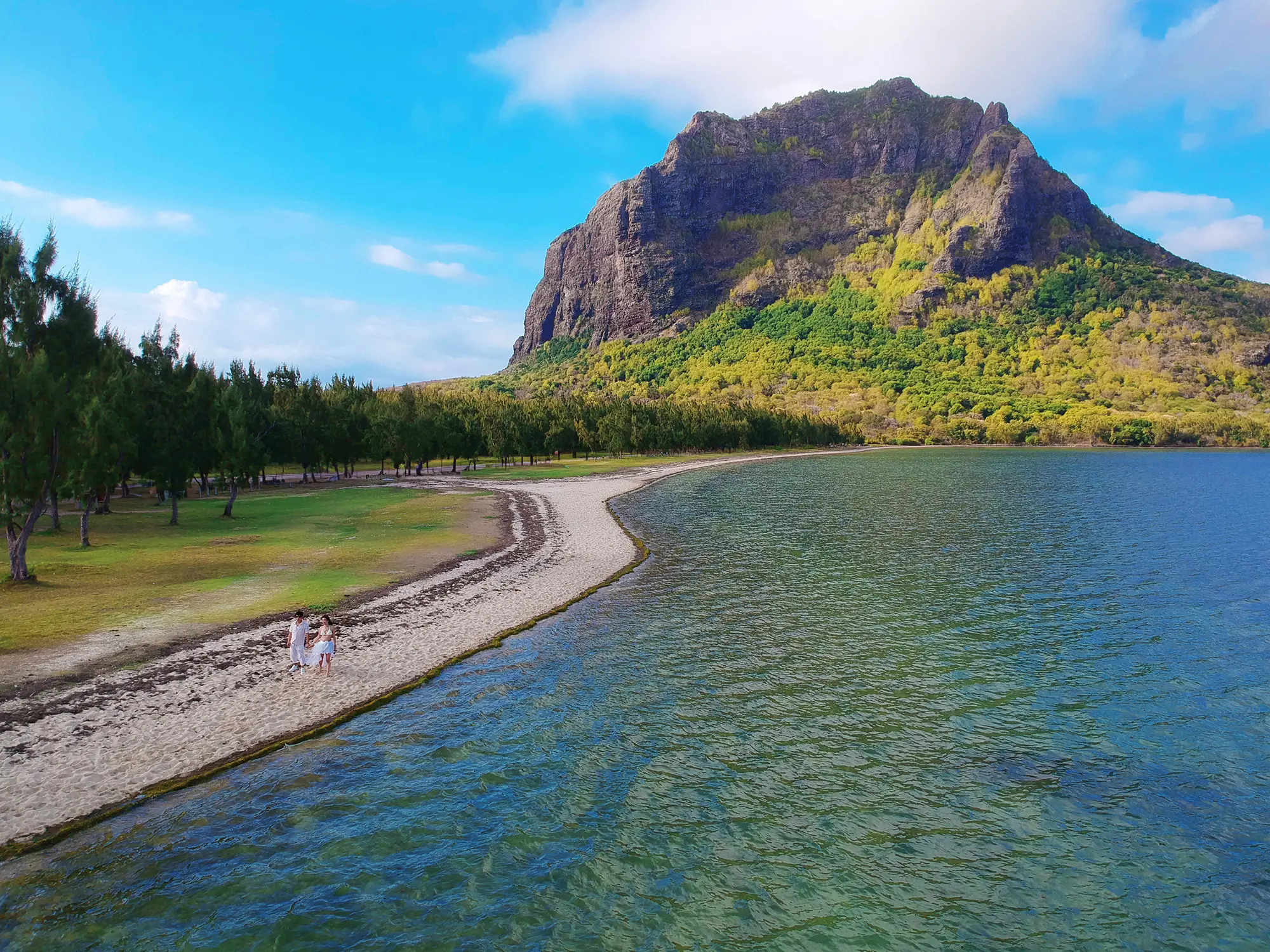
The drone: After I introduced myself and the initial shock and laughter and Sofia examining her ring had settled, I launched the drone for a ten-minute aerial session. The sun was below the horizon by then but the sky above Le Morne was still burning, pink and deep red, and from forty metres the cliff and the couple and the empty beach and the lagoon composed into an image that ground level simply cannot achieve. These aerial frames became the first images Antoine shared on Instagram that evening.
Afterwards
I delivered the full edited gallery within 48 hours — 87 final images plus the drone footage, retouched in my standard cinematic style, via Google Drive. I include a small selection of straight-to-print crops at A3 and A4 dimensions for the frames I know will end up on walls.
Antoine's WhatsApp message came in two days later, on a Thursday morning. It was brief: "She said yes and cried twice more when she saw the photos."
That message is why I do this.
The proposal itself lasts four minutes. The photographs last forever. Sofia will look at the frame of her hands on her face — the cliff lit amber behind Antoine on one knee — for the rest of her life. Her children will see it. Her grandchildren will see it. Whatever happens between now and then, that moment at Le Morne at golden hour is permanently, precisely preserved.
This is the specific responsibility and the specific privilege of secret proposal photography. The couple trust you with the most intimate moment of their relationship. You repay that trust by being invisible when invisibility matters, and by having everything technically correct so that when the light and the emotion align — and they will align, for perhaps ninety seconds, and never again in quite the same way — you do not miss it.
What Makes a Proposal Shoot Work
I have been asked many times what separates a successful secret proposal shoot from a failed one. Based on this shoot and the others I have done, it comes down to four things.
Planning without rigidity
You plan everything you can control: the location, the time of day, the signal, the concealment position, the lens choice, the exposure settings. You plan until the plan is second nature. And then you hold all of it lightly, because the wind will change, the cloud will appear, the couple will stop fifteen metres from where you expected, and the signal will come ten minutes earlier than the agreed time. The plan is not a script. It is a framework. Everything within it is flexible.
Patience as a technical skill
I spent two hours in the casuarina trees before the couple arrived. That is not waiting — that is preparation. In those two hours I adjusted my position three times as the light shifted. I checked and rechecked my settings as the cloud moved in and then cleared. I identified the exact frame I wanted — the cliff, the couple, the lagoon — and I mentally rehearsed how I would get to it when the signal came. By the time Antoine touched his hair, I had been ready for ninety minutes. The moment lasted four seconds. I did not miss a frame.
Reading body language
The signal is useful, but experienced eyes do not need it. By the time Antoine touched his hair, I had already identified three other physical signals that he was about to move: the hand going to the pocket, the slightly too-long pause looking at the ocean, the way he turned his body to a specific angle to give me the clearest view. He had not rehearsed any of this — it is simply what bodies do when they are about to do something significant. Learning to read these pre-signals means you are already shooting before the defined signal comes.
Trusting the light at Le Morne
This is specific to this location. In fifteen years of shooting at Le Morne, I have never had a sunset that did not deliver something. Even on overcast days, the last twenty minutes before dark tend to produce extraordinary colour beneath the cloud. The cliff amplifies the light — it catches and holds the amber even after the direct sunlight has gone, acting as a warm reflector that fills the faces of anyone standing in front of it. No other location on the island does this. Ile aux Cerfs is beautiful. Belle Mare is spectacular at sunrise. The north coast at Mon Choisy is calm and warm. But for a sunset proposal with a dramatic natural backdrop, Le Morne has no equal in Mauritius.
Antoine picked the right spot. He just did not know quite how right until the light appeared forty minutes before sunset and the cliff turned amber and the lagoon went still and the Indian Ocean did what it does.
Le Morne Proposal Photography — FAQ
Capture Your Mauritius Memories
The Indian Ocean. The two of you. 3-day delivery so you have your gallery before you fly home.
Ready to confirm your date?
Pay €80 Deposit to Hold Your DateDeposit deducted from total. Fully refundable if Bilaal is unavailable.